Practical Roadmap for Biomedical Engineering Students to Learn Artificial Intelligence in Healthcare
Introduction
Artificial Intelligence (AI) is reshaping the future of medicine, creating unprecedented opportunities for biomedical engineers. Yet, many students struggle with the question: “Where should I start my journey in AI for healthcare?” Should they begin by coding neural networks immediately, or first immerse themselves in theory and concepts?
The truth is: success lies in balance. Biomedical engineering students must first understand the fundamental concepts of AI in healthcare—its ethical implications, types of medical data, and regulatory frameworks. But this should not consume years of study. Instead, students need structured, simplified guidance that ensures a solid foundation without delaying the hands-on practice that truly builds expertise.
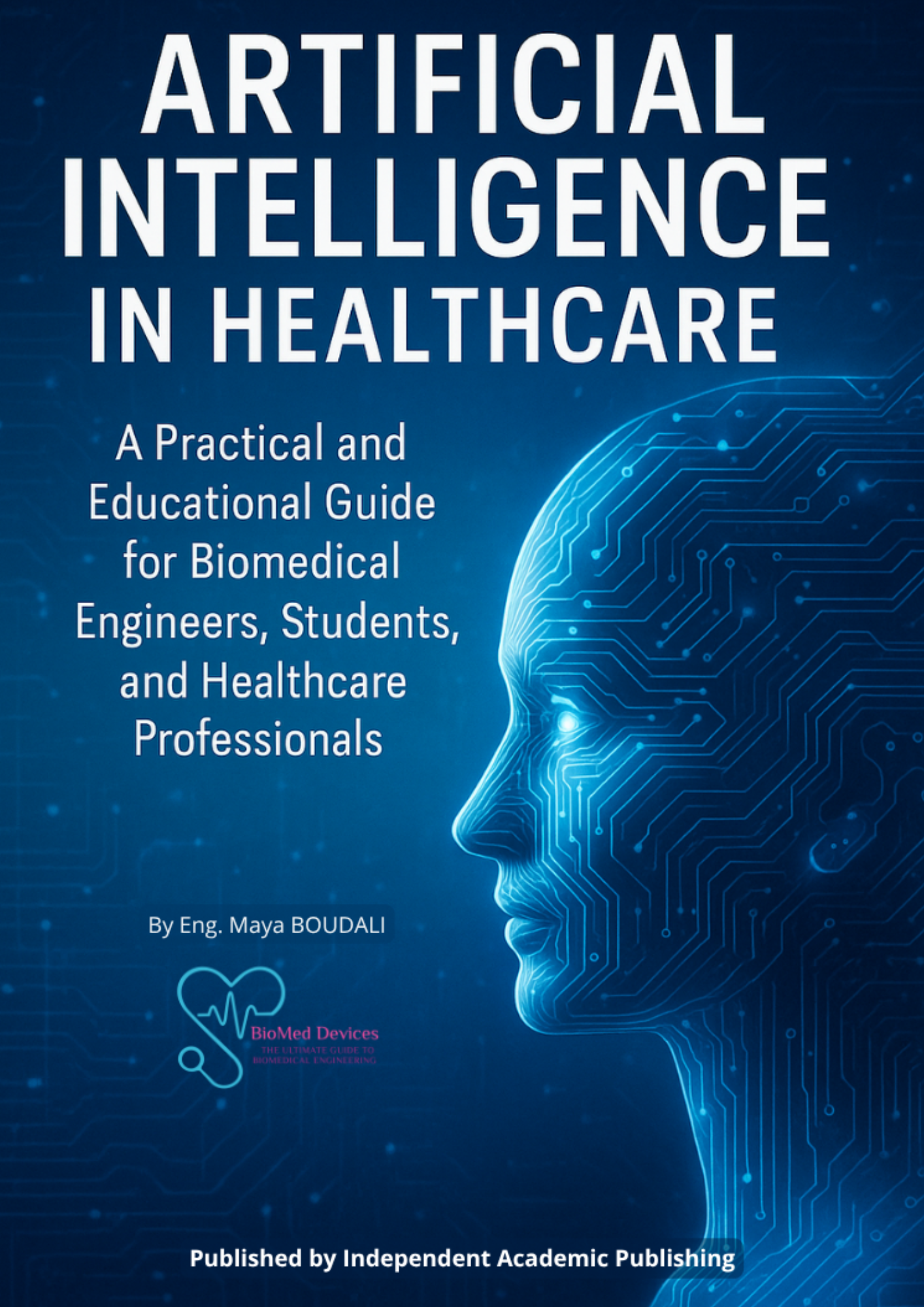
This roadmap provides a practical sequence: start with foundational understanding, then move quickly into applied learning, programming, and real-world projects. It also highlights how Artificial Intelligence in Healthcare: A Practical and Educational Guide for Biomedical Engineers, Students, and Healthcare Professionals supports this journey by simplifying complex concepts and bridging them with practical applications.
Step 1: Understand the Core Concepts of AI in Healthcare
Why Start Here?
Jumping into coding without understanding the context, ethics, and nature of medical data can lead to misinformed applications that fail to address real-world needs. A biomedical engineer must first grasp:
- What AI is and isn’t in the healthcare context.
- Types of medical data: images, signals, genomics, and EHRs.
- Ethical considerations: privacy, fairness, bias, and accountability.
- Regulations: HIPAA, GDPR, and FDA/EMA standards for AI-based medical devices.
How to Approach It
- Focus on a trusted, simplified source that explains these concepts clearly and concisely (such as the book mentioned).
- Spend a few weeks—not years—building this foundation. The goal is comprehension, not memorization.
This ensures that when students later code AI models, they understand the clinical, ethical, and regulatory significance of what they are building.
Step 2: Move Quickly Into Applied Learning
Why It Matters
While concepts are essential, the true skill of an AI biomedical engineer comes from practical application. Building and experimenting with models develops problem-solving ability, intuition, and confidence.
How to Do It
- Learn Python: Start coding with libraries like NumPy, Pandas, and Scikit-learn.
- Explore AI frameworks: PyTorch and TensorFlow.
- Work with healthcare datasets: PhysioNet (ECG), NIH Chest X-ray dataset, TCGA (genomics).
- Build small projects: Classify chest X-rays, detect arrhythmias in ECG, or analyze hospital readmission data.
At this stage, students will feel the transition from knowing about AI to doing AI.
Step 3: Specialize in Healthcare Applications
Once comfortable with basics, biomedical engineering students should dive deeper into healthcare-specific AI:
- Medical Imaging: Learn convolutional neural networks (CNNs) and tools like MONAI.
- Signal Processing: Apply AI to ECG, EEG, or wearable device data.
- Natural Language Processing (NLP): Extract insights from clinical notes and EHRs.
- Drug Discovery and Genomics: Explore how AI accelerates personalized medicine.
Projects at this stage could include:
- Predicting sepsis using ICU data.
- Automating tumor detection in pathology slides.
- Developing AI-based decision-support tools for doctors.
Step 4: Integrate Ethics, Regulation, and Real-World Collaboration
No AI in healthcare can succeed without addressing:
- Explainability: Can clinicians trust the AI’s decisions?
- Bias Mitigation: Does the model perform fairly across diverse populations?
- Compliance: Does it meet medical device regulations?
Students should also collaborate with clinicians to ensure their projects solve genuine problems.
Step 5: Build a Portfolio and Stay Updated
- Showcase projects on GitHub or personal websites.
- Attend conferences like MICCAI, RSNA, or IEEE EMBS.
- Keep updated with The Lancet Digital Health, Nature Medicine, and AI/ML healthcare journals.
- Network with peers, clinicians, and AI professionals.
This positions students for internships, research opportunities, or advanced studies in AI-driven biomedical engineering.
Conclusion: Balance First Principles with Application
The key takeaway is this:
- Foundational understanding (concepts, ethics, regulations, data types) provides context.
- Applied learning and coding build the real skills that make students employable and impactful.
- Spending too long on theory without application leads to stagnation, while diving into coding without context leads to misguided solutions.
Biomedical engineering students must master both—starting with a structured, simplified foundation, then moving quickly into practice.
A Resource for Your Journey
If you are a biomedical engineering student beginning this path, Artificial Intelligence in Healthcare: A Practical and Educational Guide for Biomedical Engineers, Students, and Healthcare Professionals is designed precisely for you.
- It simplifies core concepts—AI basics, ethics, regulations, and data types—so you can grasp them efficiently.
- It provides practical case studies in radiology, cardiology, oncology, and telemedicine.
- It includes guided reflections and exercises to ensure you can connect knowledge with practice.
- It helps you transition smoothly from understanding to building.
In short, it ensures you don’t get lost in theory or rush blindly into coding, but instead develop a balanced, practical, and impactful mastery of AI in healthcare.
Get your copy from here