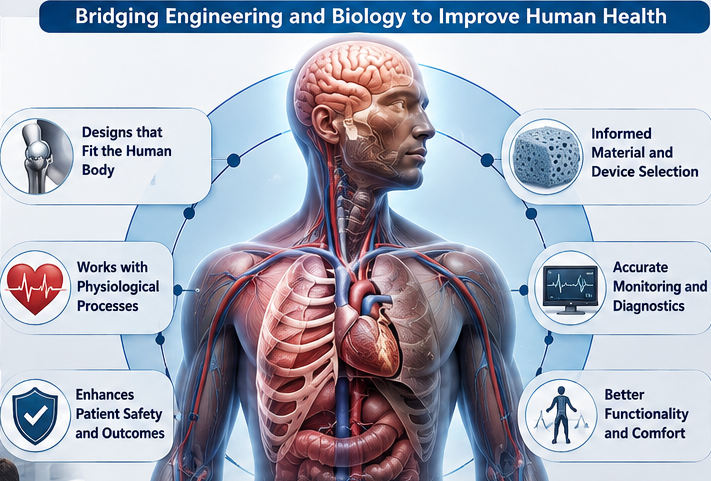
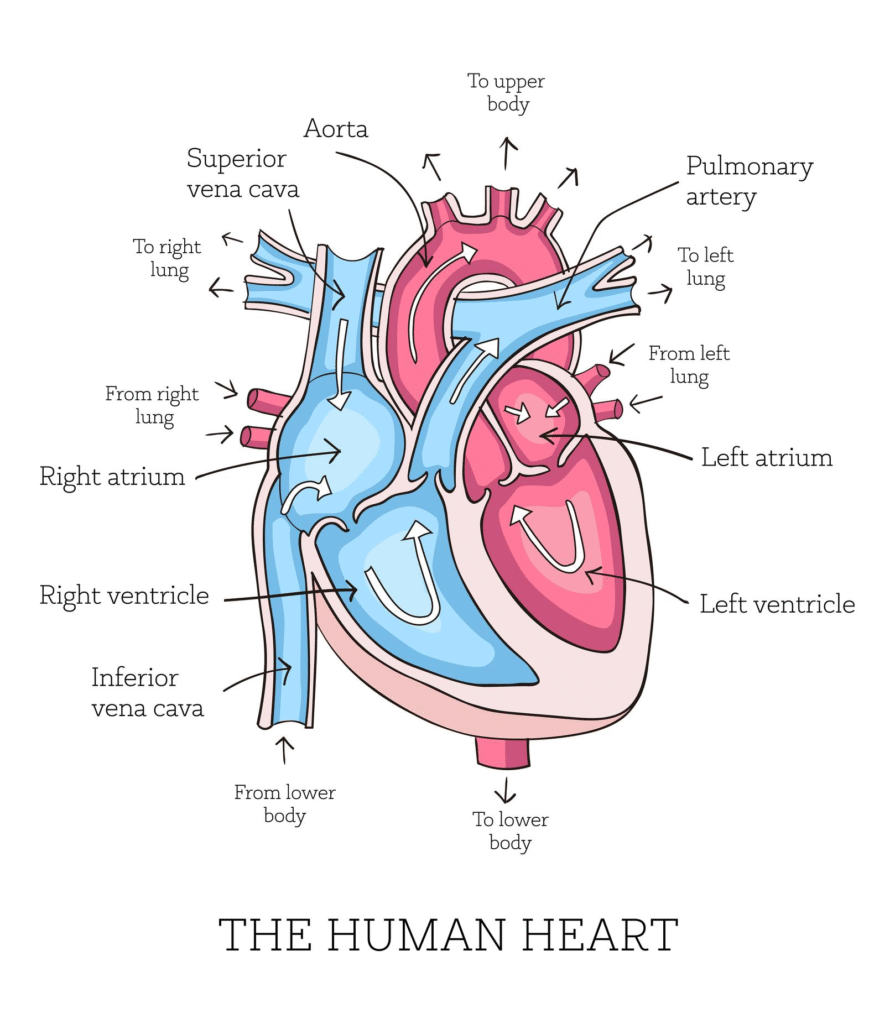
Anatomy and Physiology Fundamentals Every Biomedical Engineer Should Know
Table of Contents
- Introduction: Why Anatomy & Physiology Matter for Biomedical Engineers
- Defining Anatomy and Physiology from an Engineering Standpoint
- Anatomical Reference Systems and Spatial Organization
- The Anatomical Position
- Body Planes
- Directional Terms
- Anatomical Axes and Human Motion
- Application to Medical Imaging and Navigation Systems
- Common Engineering Errors Without Proper Anatomical Referencing
- Hierarchical Organization of the Human Body
- Molecular and Cellular Level
- Tissue Level
- Organ Level
- Organ System Level
- Core Physiological Principles Every Biomedical Engineer Must Master
- Transport Phenomena in Biology
- Biological Signaling and Information Flow
- Control Systems and Homeostasis
- Quantitative Physiological Parameters Relevant to Engineering
- Structure–Function Relationships: An Engineering Lens
- Anatomy & Physiology as Inputs to Medical Device Design
- Common Pitfalls When Engineers Learn Biology
- How This Foundation Supports Advanced Biomedical Engineering Fields
- References
1. Introduction: Why Anatomy & Physiology Matter for Biomedical Engineers
For biomedical engineers, anatomy and physiology are not memorization subjects — they are system specifications.
Unlike medical education, which focuses on diagnosis and treatment, biomedical engineering requires understanding the human body as:
- A multi-scale system
- Governed by physical laws
- Producing measurable signals
- Interacting with external devices
Every medical device — from an ECG electrode to an MRI scanner — interfaces with:
- A specific anatomical structure
- Operating under specific physiological constraints
Without a solid foundation in anatomy and physiology:
- Signals are misinterpreted
- Devices are poorly designed
- Safety margins are misunderstood
2. Defining Anatomy and Physiology from an Engineering Standpoint
Anatomy (Structural Domain)
Anatomy describes:
- The geometry
- Spatial relationships
- Material composition
of biological components.
For engineers, anatomy answers:
- Where is the signal generated?
- What tissues does energy pass through?
- What mechanical or electrical properties exist at the interface?
Physiology (Functional Domain)
Physiology describes:
- Dynamic processes
- Transport, signaling, and regulation
- Time-dependent behavior of biological systems
For engineers, physiology answers:
- How does the system behave over time?
- What are normal operating ranges?
- What feedback mechanisms exist?
Key engineering insight:
Anatomy defines boundary conditions.
Physiology defines system dynamics.
3. Anatomical Reference Systems and Spatial Organization
3.1 Why Anatomical Reference Systems Matter in Biomedical Engineering
In engineering, nothing exists without a reference frame.
Likewise, in anatomy:
- Position
- Direction
- Orientation
- Movement
are meaningless without a standardized spatial system.
For biomedical engineers, anatomical reference systems are essential for:
- Mapping physiological signals to physical locations
- Aligning medical images across modalities (CT, MRI, ultrasound)
- Defining motion in gait analysis and biomechanics
- Designing devices that interface with the body reproducibly
Key idea:
Anatomical reference systems are the Cartesian coordinates of the human body.
3.2 The Anatomical Position: The Global Reference Configuration
Definition
The anatomical position is the standardized reference posture used to describe the human body:
- Body standing upright
- Head facing forward
- Eyes looking ahead
- Upper limbs at the sides
- Palms facing forward
- Lower limbs together, feet flat and forward
This position is not arbitrary — it is the zero-reference state.
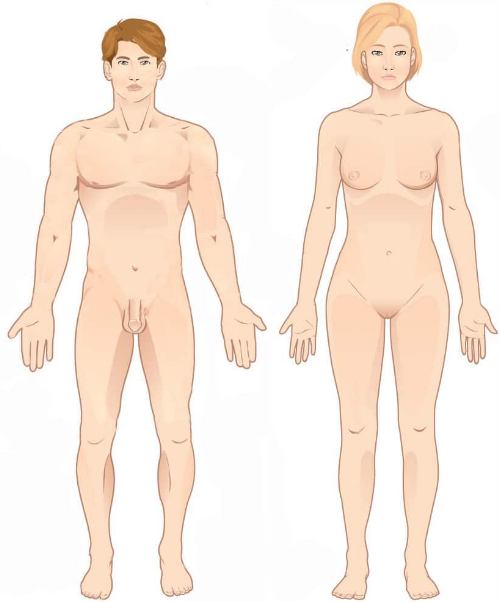
The standard anatomical position used when describing human anatomy
Engineering Interpretation
| Engineering Concept | Anatomical Equivalent |
|---|---|
| Zero-load configuration | Anatomical position |
| Global reference frame | Standard anatomical orientation |
| Calibration pose | Baseline anatomical posture |
All anatomical descriptions assume this position even if the patient is lying down, moving, or inverted.
Engineering Relevance
- Motion capture systems define joint angles relative to anatomical position
- Prosthetics are aligned based on this reference
- Imaging orientations assume anatomical position for labeling axes
- Robotics and exoskeletons use it as the neutral pose
3.3 Body Planes: Anatomical Coordinate Planes
Body planes divide the body into sections and act as orthogonal reference planes, similar to X–Y–Z planes.
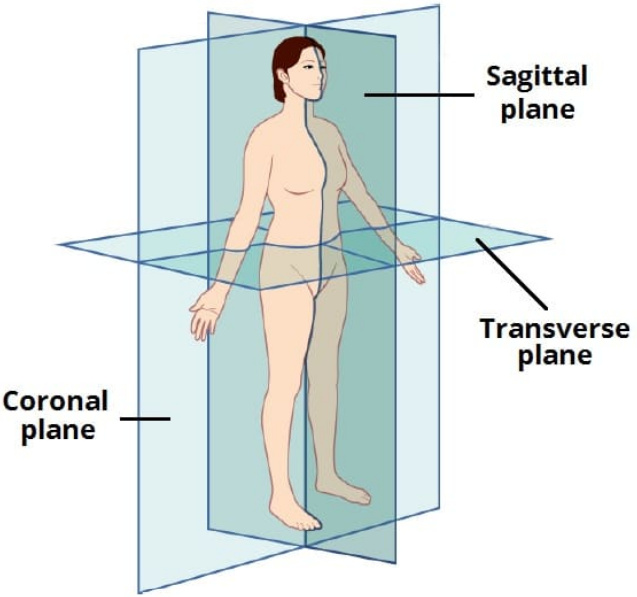
The anatomical planes of the human body
3.3.1 Sagittal Plane
Divides the body into left and right portions.
- Midsagittal: equal halves
- Parasagittal: unequal halves
Engineering relevance
- Gait analysis
- Flexion/extension movements
- Left–right asymmetry detection
- Spinal alignment measurements
Typical signals
- EMG during walking
- Joint angle trajectories
3.3.2 Frontal (Coronal) Plane
Divides the body into anterior (front) and posterior (back) portions.
Engineering relevance
- Balance and postural control
- Fall detection systems
- Lateral motion analysis
- Shoulder and hip abduction mechanics
3.3.3 Transverse (Horizontal) Plane
Divides the body into superior (upper) and inferior (lower) portions.
Engineering relevance
- CT and MRI slice orientation
- Rotational biomechanics
- Organ localization
- Cross-sectional imaging reconstruction
Engineering Mapping Summary
| Anatomical Plane | Engineering Analogy |
|---|---|
| Sagittal | Y–Z plane |
| Frontal | X–Z plane |
| Transverse | X–Y plane |
3.4 Directional Terms: Anatomical Vector Language
Directional terms define relative position and direction, functioning like vector descriptors.
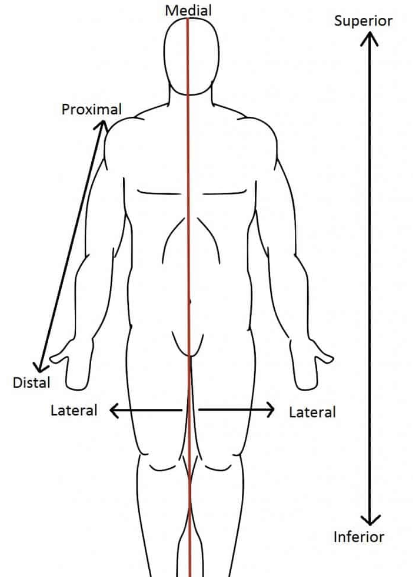
Anatomical terms of location labelled on the anatomical position
Core Directional Terms
| Term | Meaning | Engineering Use Case |
|---|---|---|
| Superior / Inferior | Toward head / feet | Device positioning |
| Anterior / Posterior | Front / back | Imaging orientation |
| Medial / Lateral | Toward / away from midline | Signal localization |
| Proximal / Distal | Closer / farther from origin | Limb mechanics |
| Superficial / Deep | Toward surface / interior | Sensor depth |
Engineering Insight
- “Proximal” and “distal” define distance along a kinematic chain
- “Medial” and “lateral” define symmetry axes
- “Deep” vs “superficial” affects:
- Signal attenuation
- Electrode placement
- Ultrasound penetration
3.5 Anatomical Axes and Human Motion
Motion occurs around axes, perpendicular to planes.
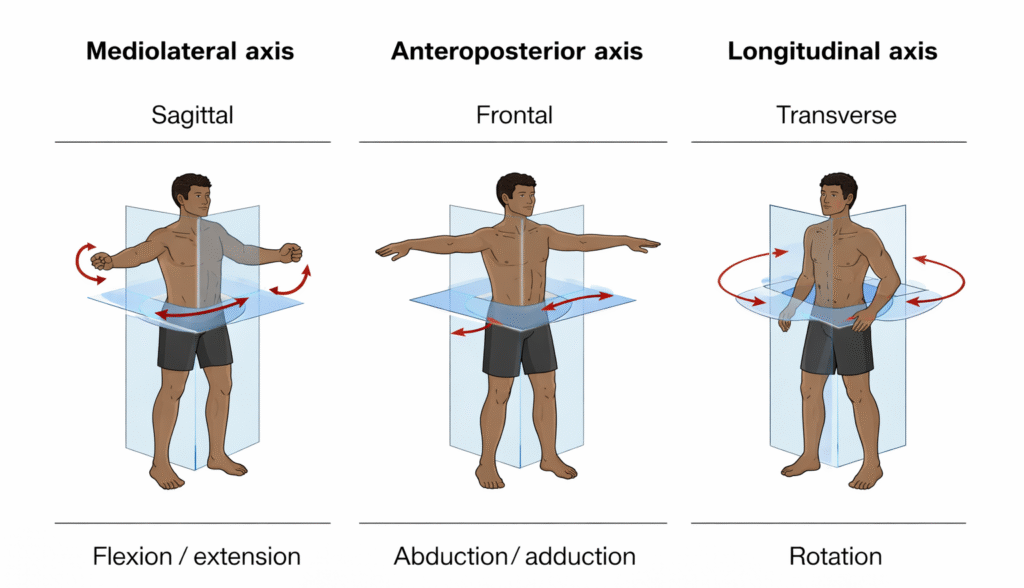
| Axis | Associated Plane | Motion Type |
|---|---|---|
| Mediolateral axis | Sagittal | Flexion / extension |
| Anteroposterior axis | Frontal | Abduction / adduction |
| Longitudinal axis | Transverse | Rotation |
Engineering relevance
- Joint kinematics
- Robotic limb modeling
- IMU-based motion tracking
- Rehabilitation devices
3.6 Application to Medical Imaging and Navigation Systems
Anatomical reference systems are embedded in:
- DICOM standards
- Image reconstruction algorithms
- Surgical navigation systems
- Radiation therapy planning
Example
- CT images are reconstructed in the transverse plane
- MRI can be re-sliced computationally into sagittal or frontal planes
- Navigation systems register patient anatomy to a global coordinate frame
3.7 Common Engineering Errors Without Proper Anatomical Referencing
- Misinterpreting imaging orientations
- Incorrect sensor alignment
- Confusing left/right or anterior/posterior
- Invalid comparison across subjects or datasets
These are not small errors — they can invalidate entire analyses.
4. Hierarchical Organization of the Human Body
Biomedical engineers must think bottom-up and top-down simultaneously.
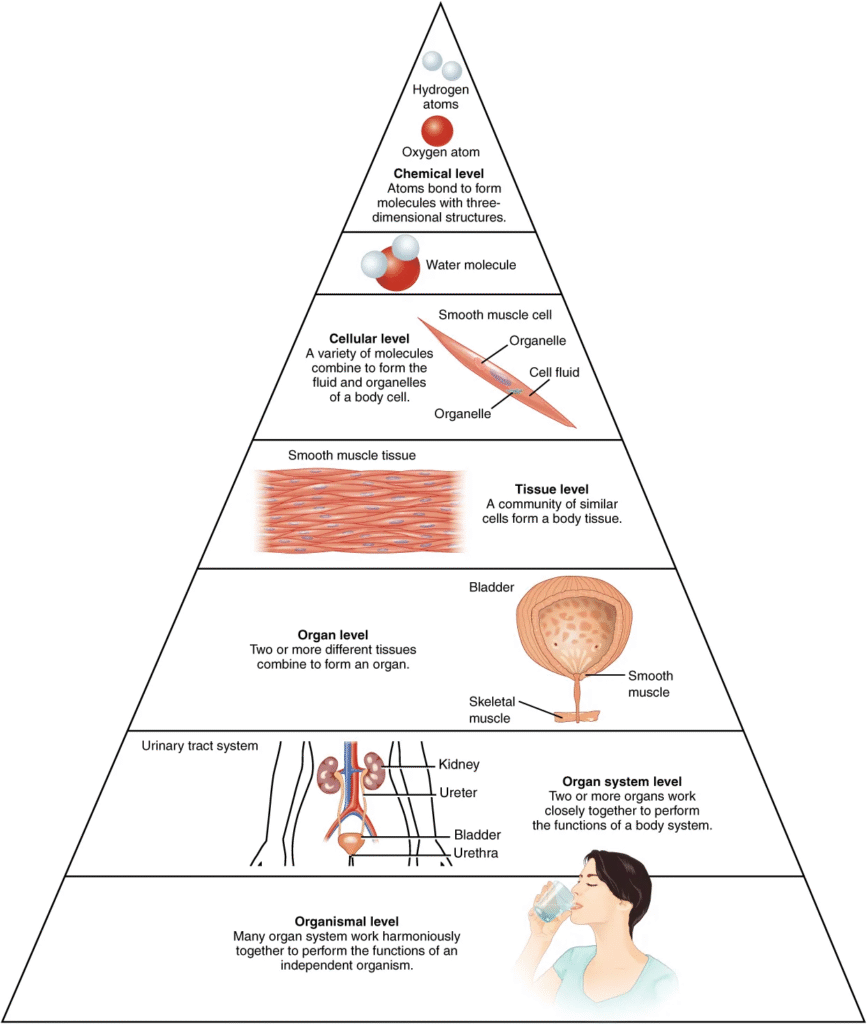
Levels of Structural Organization of the Human Body
4.1 Molecular and Cellular Level
At the smallest functional scale:
- Proteins act as sensors, actuators, and channels
- Ion gradients generate electrical potentials
- Enzymes define reaction rates
Engineering relevance
- Ion channels → bioelectric models (Hodgkin–Huxley)
- Membranes → capacitive elements
- Receptors → input transducers
Cells are the fundamental signal-processing units of biology.
4.2 Tissue Level
Tissues are organized cellular assemblies optimized for specific functions:
| Tissue Type | Engineering Interpretation |
|---|---|
| Epithelial | Barrier + selective transport membrane |
| Connective | Load-bearing & structural matrix |
| Muscle | Force and motion actuator |
| Nervous | High-speed information transmission |
Engineering relevance
- Ultrasound attenuation depends on tissue composition
- Electrical impedance varies across tissue types
- Mechanical stiffness affects prosthetic and implant design
4.3 Organ Level
Organs are integrated subsystems with:
- Defined inputs and outputs
- Internal control mechanisms
- Measurable performance metrics
Examples:
- Heart → pressure–flow pump
- Lung → gas exchange membrane
- Kidney → filtration and control system
Engineering relevance
- Organs can be modeled using lumped-parameter models
- Device design often targets organ-level outputs
4.4 Organ System Level
Systems emerge when organs interact:
| System | Primary Engineering Function |
|---|---|
| Cardiovascular | Transport & distribution |
| Respiratory | Mass transfer (O₂, CO₂) |
| Nervous | Control and communication |
| Musculoskeletal | Force generation and motion |
| Renal | Regulation and filtration |
System-level understanding is essential for:
- Multi-sensor integration
- Closed-loop medical devices
- Patient monitoring systems
5. Core Physiological Principles Every Biomedical Engineer Must Master
5.1 Transport Phenomena in Biology
Biological systems obey the same transport laws as engineered systems.
| Mechanism | Engineering Analogy |
|---|---|
| Diffusion | Fick’s laws |
| Convection | Fluid flow |
| Active transport | Energy-driven pumps |
Engineering relevance
- Drug delivery modeling
- Oxygen transport in tissues
- Dialysis system design
5.2 Biological Signaling and Information Flow
Signals in the body include:
- Electrical (ECG, EEG, EMG)
- Chemical (hormones)
- Mechanical (pressure, stretch)
Engineering relevance
- Signal bandwidth and noise matter
- Tissue acts as a filter and attenuator
- Sensors must match signal characteristics
5.3 Control Systems and Homeostasis
Physiology is full of feedback loops.
Examples:
- Blood pressure regulation
- Blood glucose control
- Temperature regulation
Engineering interpretation
- Sensors → controllers → actuators
- Mostly negative feedback
- Nonlinear, adaptive control systems
This is the conceptual backbone of:
- Closed-loop insulin pumps
- Adaptive ventilators
- Smart monitoring systems
6. Quantitative Physiological Parameters Relevant to Engineering
Biomedical engineers must know orders of magnitude, not just concepts.
| Parameter | Typical Range |
|---|---|
| Blood pressure | ~120/80 mmHg |
| Heart rate | 60–100 bpm |
| Cardiac output | ~5 L/min |
| Neural action potential | ~100 mV |
| Tissue impedance | Frequency-dependent |
These values define:
- Sensor specifications
- Safety limits
- Calibration requirements
7. Structure–Function Relationships: An Engineering Lens
In biology:
Structure is optimized for function under constraints
Examples:
- Alveoli maximize surface area → gas exchange
- Myelin reduces capacitance → faster signal transmission
- Bone trabeculae align with stress lines → load optimization
Engineering relevance
- Biomimetic design
- Material selection
- Failure mode analysis
8. Anatomy & Physiology as Inputs to Medical Device Design
Every device must answer:
- Where does it interface anatomically?
- What physiological variable does it measure or modify?
- How does tissue affect signal transmission?
Examples:
- ECG electrodes → skin + muscle + fat layers
- Ultrasound probes → acoustic impedance matching
- Implants → immune response and tissue remodeling
8. Common Pitfalls When Engineers Learn Biology
- Memorizing anatomy without understanding function
- Ignoring variability between individuals
- Applying linear models blindly
- Treating biology as static
A systems mindset avoids all four.
9. How This Foundation Supports Advanced Biomedical Engineering Fields
This article is a gateway to:
- Biomedical signal processing
- Medical imaging physics
- Biomechanics
- Biomaterials
- Clinical engineering
- Computational physiology
Without these fundamentals, advanced topics collapse.
References
- Guyton, A. C., & Hall, J. E. Textbook of Medical Physiology. Elsevier.
- Tortora, G. J., & Derrickson, B. H. Principles of Anatomy and Physiology. Wiley.
- Enderle, J. D., Bronzino, J. D., & Blanchard, S. M. Introduction to Biomedical Engineering. Academic Press.
- Fung, Y. C. Biomechanics: Mechanical Properties of Living Tissues. Springer.
- Keener, J., & Sneyd, J. Mathematical Physiology. Springer.
- Hall, J. E. (2020). Guyton and Hall Textbook of Medical Physiology (14th ed.). Elsevier.
- https://www.elsevier.com/books/guyton-and-hall-textbook-of-medical-physiology/hall/978-0-323-59712-8 Standring, S. (2020). Gray’s Anatomy: The Anatomical Basis of Clinical Practice (42nd ed.). Elsevier.
- https://www.elsevier.com/books/grays-anatomy/standring/978-0-7020-7707-4 OpenStax. Anatomy and Physiology. Rice University.
- https://openstax.org/details/books/anatomy-and-physiology National Cancer Institute (NIH). Cells, Tissues, and Membranes.
- https://training.seer.cancer.gov/anatomy/cells_tissues_membranes/ Cleveland Clinic. Endocrine System Overview.
- https://my.clevelandclinic.org/health/body/21201-endocrine-system Britannica. Human Body.
- https://www.britannica.com/science/human-body Khan Academy. Homeostasis and Physiology.
- https://www.khanacademy.org/science/biology/principles-of-physiology StatPearls Publishing. Physiology Overview. NCBI Bookshelf.
- https://www.ncbi.nlm.nih.gov/books/ Mayo Clinic. Human Body Systems.
- https://www.mayoclinic.org TeachMeAnatomy. Anatomical Terminology.
- https://teachmeanatomy.info/the-basics/anatomical-terminology/terms-of-location/