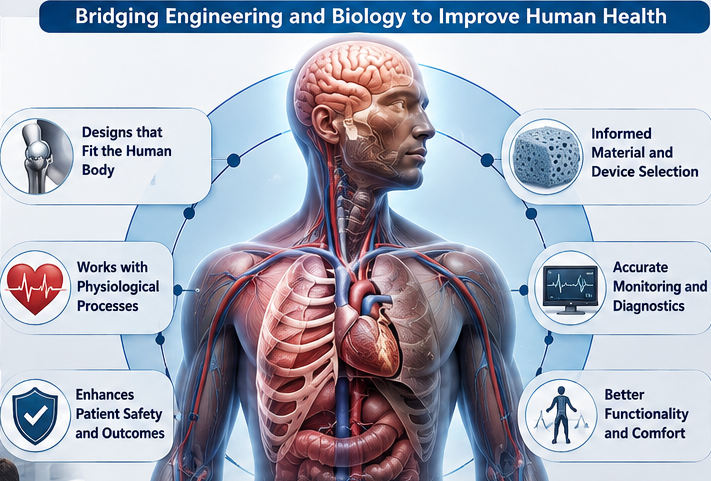
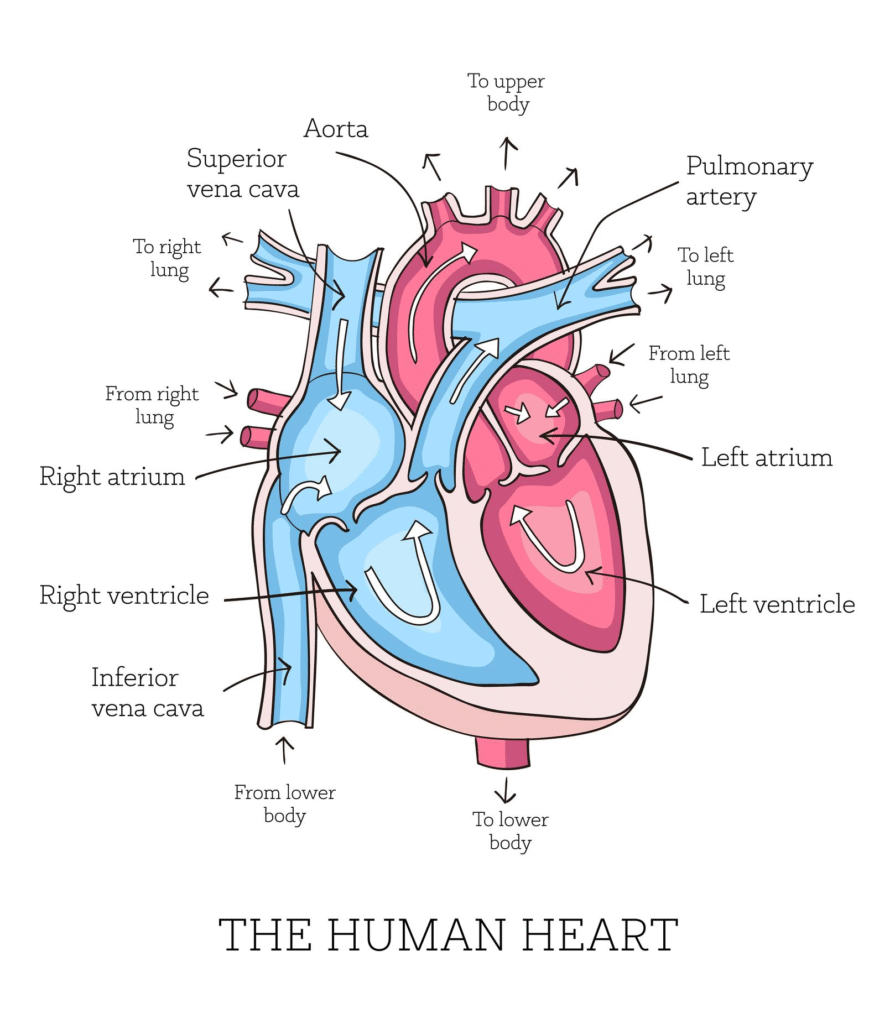
The Nervous System: Anatomy, Physiology, Functions, and Clinical Significance
Introduction
The nervous system is one of the most sophisticated and essential systems in the human body. It serves as the body’s communication and control network, allowing us to think, feel, move, learn, remember, and respond to our environment. Every heartbeat, breath, muscle contraction, emotion, and thought depends on the proper functioning of the nervous system.
From a physiological perspective, the nervous system continuously receives information, processes it, and generates appropriate responses. From an anatomical perspective, it consists of specialized organs, tissues, and cells that work together to coordinate body functions.
A useful analogy is to compare the nervous system to a country’s communication infrastructure:
- The brain acts as the central headquarters.
- The spinal cord functions as the main communication highway.
- The nerves resemble telephone and internet cables carrying information throughout the body.
- Neurons act like individual communication units transmitting messages.
Understanding the nervous system is fundamental for students of anatomy, physiology, medicine, nursing, neuroscience, and biomedical engineering because it connects virtually every other body system.
Table of Contents
- Introduction
- Overview of the Nervous System
- Functions of the Nervous System
- Structural Organization
- Neurons: The Functional Units
- Neuroglia (Glial Cells)
- Electrical Communication in Neurons
- Synapses and Neurotransmitters
- The Autonomic Nervous System
- Reflexes
- Sensory and Motor Pathways
- Protection of the Nervous System
- Clinical Relevance
- Practical Examples
- Summary Points
- Conclusion
- Academic References
1- Overview of the Nervous System
The nervous system is responsible for:
- detecting internal and external stimuli
- processing information
- coordinating responses
- maintaining homeostasis
- controlling voluntary and involuntary actions
The nervous system operates much faster than the endocrine system because it uses electrical signals rather than hormones as its primary communication method.
2- Functions of the Nervous System
The nervous system performs three major functions:
1. Sensory Function
Sensory receptors detect changes in the environment.
Examples include:
- light entering the eyes
- sound reaching the ears
- temperature changes on the skin
- pain signals from injured tissues
These signals travel toward the brain and spinal cord.
2. Integrative Function
The brain and spinal cord analyze incoming information.
During integration, the nervous system:
- interprets signals
- stores memories
- makes decisions
- plans responses
For example, if you touch a hot object, the brain determines that the sensation represents potential tissue damage.
3. Motor Function
After processing information, the nervous system sends commands to:
- muscles
- glands
- organs
This produces an appropriate response.
Example:
- pulling your hand away from a hot stove
- increasing heart rate during exercise
3- Structural Organization of the Nervous System
The nervous system is divided into two major parts:
| Division | Components |
|---|---|
| Central Nervous System (CNS) | Brain and spinal cord |
| Peripheral Nervous System (PNS) | All nerves outside CNS |
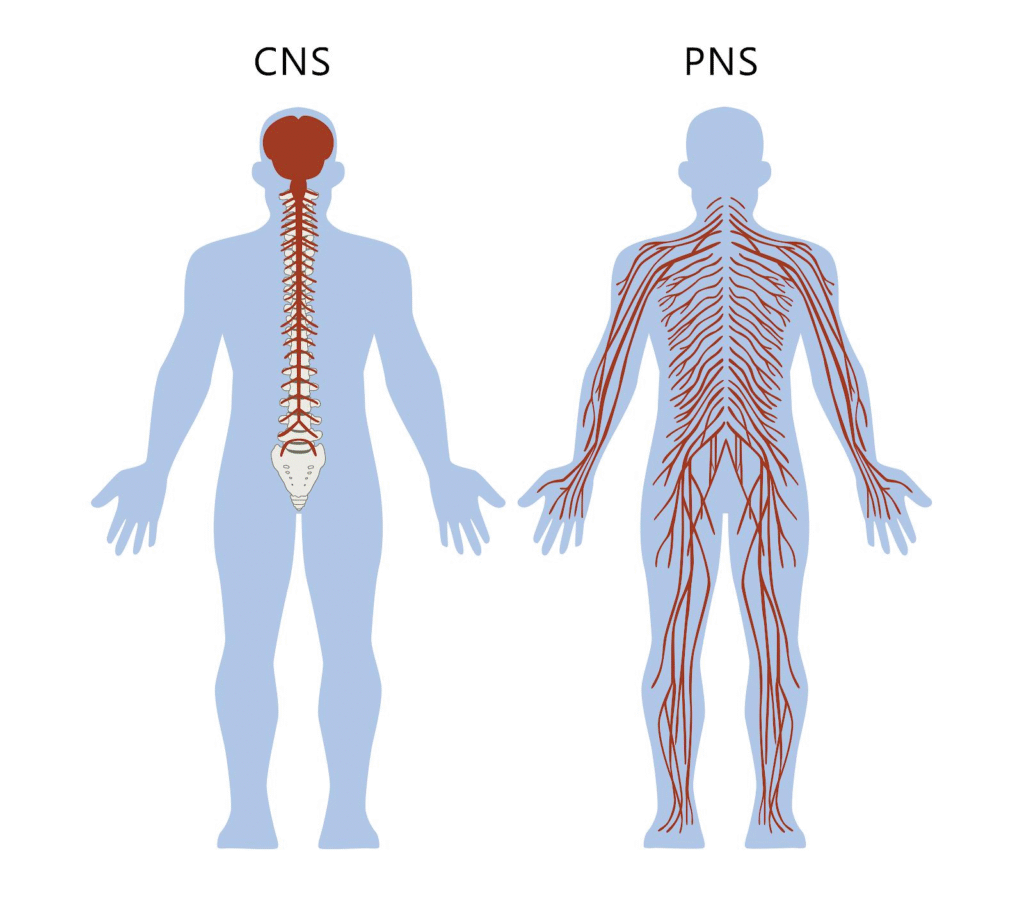
The Central Nervous System (CNS)
The CNS is the body’s processing center.
It consists of:
- Brain
- Spinal cord
The Brain
The adult brain contains approximately 86 billion neurons and serves as the body’s control center.
Major Brain Regions
| Region | Primary Function |
|---|---|
| Cerebrum | Thinking, memory, voluntary movement |
| Cerebellum | Balance and coordination |
| Brainstem | Basic life functions |
| Diencephalon | Hormonal and sensory regulation |
Cerebrum
The cerebrum is the largest part of the brain.
Functions include:
- intelligence
- language
- reasoning
- memory
- consciousness
It contains two hemispheres:
- left hemisphere
- right hemisphere
Lobes of the Cerebrum
| Lobe | Function |
|---|---|
| Frontal | Planning, movement, personality |
| Parietal | Touch and sensory processing |
| Temporal | Hearing and memory |
| Occipital | Vision |
Cerebellum
The cerebellum coordinates:
- balance
- posture
- fine motor movements
Without it, movements become uncoordinated.
Brainstem
The brainstem controls vital functions such as:
- breathing
- heart rate
- blood pressure
- swallowing
It consists of:
- midbrain
- pons
- medulla oblongata
The Spinal Cord
The spinal cord connects the brain to the rest of the body.
Functions:
- transmits information
- coordinates reflexes
The Peripheral Nervous System (PNS)
The PNS includes all nerves outside the brain and spinal cord.
It connects the CNS to:
- muscles
- organs
- skin
- glands
Components
Cranial Nerves
There are 12 pairs of cranial nerves.
Functions include:
- vision
- smell
- hearing
- facial movement
Spinal Nerves
There are 31 pairs of spinal nerves.
They connect the spinal cord to the body.
4- Neurons: The Functional Units of the Nervous System
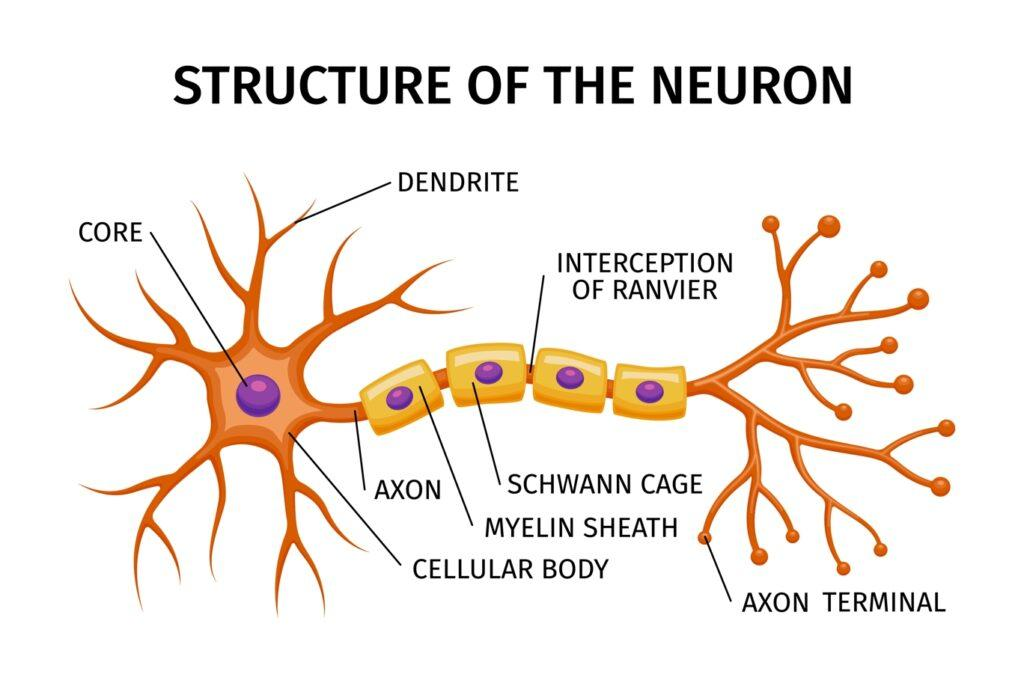
Neurons are specialized cells that transmit information.
They are the basic functional units of the nervous system.
Parts of a Neuron
Dendrites
Receive incoming signals.
Cell Body (Soma)
Contains the nucleus.
Axon
Carries signals away from the cell body.
Axon Terminals
Communicate with other cells.
Memory Tip
Think of a neuron as a tree:
- dendrites = branches
- cell body = trunk
- axon = long root
- terminals = root tips
5- Neuroglia (Glial Cells)
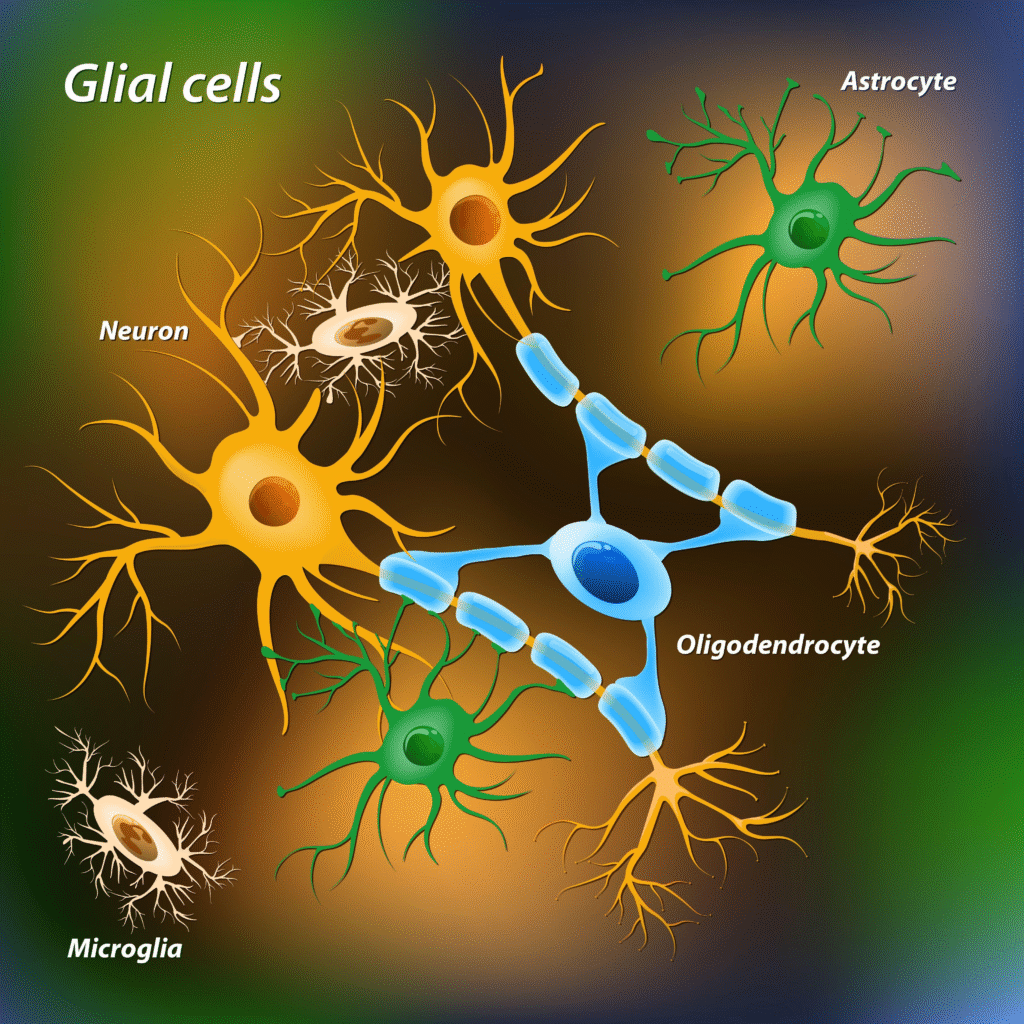
Glial cells support neurons.
Unlike neurons, they do not primarily transmit electrical signals.
Major Glial Cells
| Cell Type | Function |
|---|---|
| Astrocytes | Structural support |
| Oligodendrocytes | CNS myelin production |
| Schwann cells | PNS myelin production |
| Microglia | Immune defense |
| Ependymal cells | Cerebrospinal fluid support |
6- Electrical Communication in Neurons
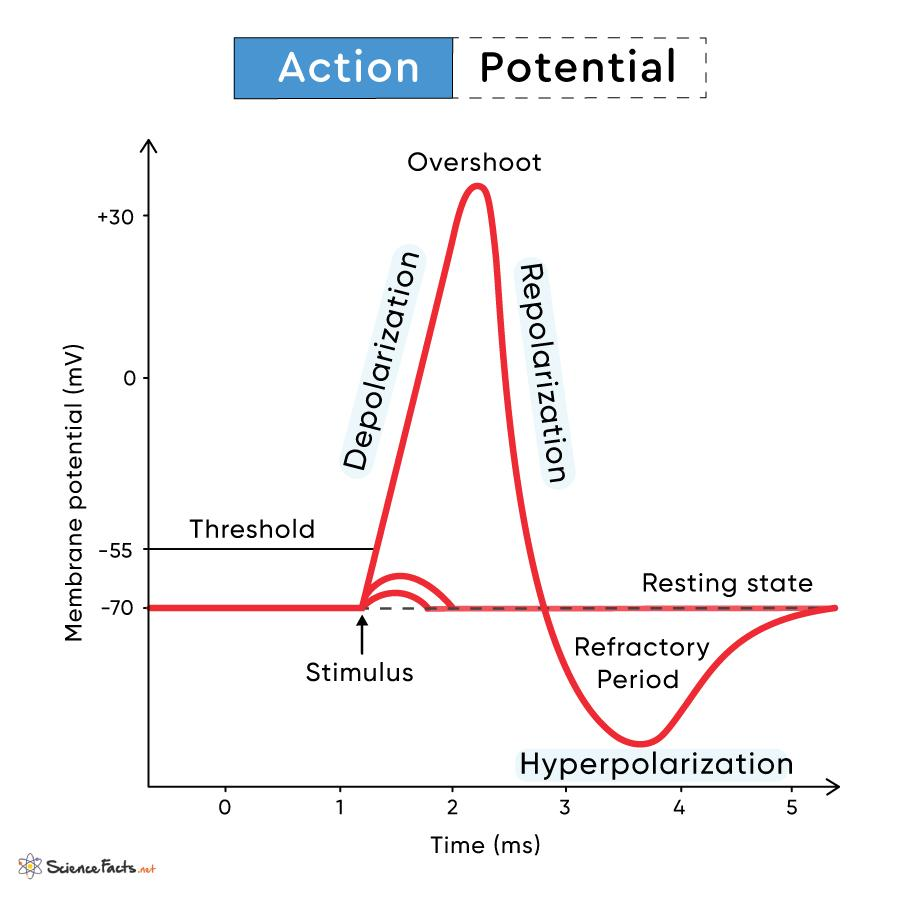
Neurons communicate using electrical signals called action potentials.
Resting Membrane Potential
When inactive, neurons maintain an electrical difference across the membrane.
Typical resting potential:
- approximately −70 mV
Action Potential
An action potential occurs when:
- Stimulus arrives
- Sodium channels open
- Membrane depolarizes
- Potassium channels open
- Repolarization occurs
This process allows rapid signal transmission.
Myelin and Signal Conduction
Myelin is a fatty insulating layer around axons.
Functions:
- increases speed
- improves efficiency
- protects nerve fibers
Saltatory Conduction
In myelinated neurons, signals jump between nodes of Ranvier.
This process greatly increases conduction speed.
6- Synapses and Neurotransmitters
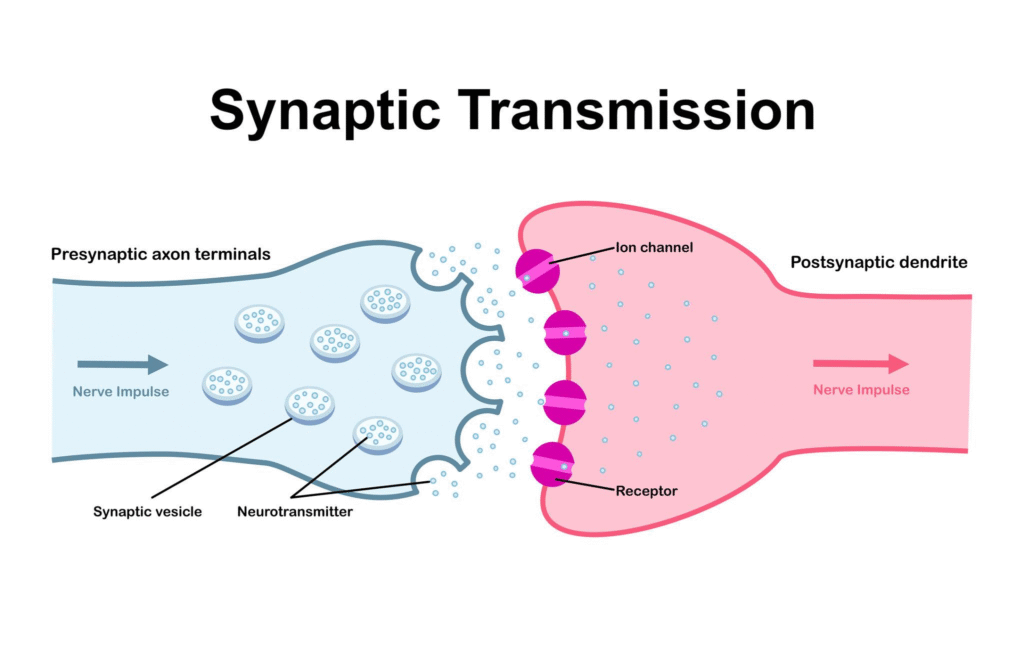
Neurons communicate at specialized junctions called synapses.
Synaptic Transmission
- Action potential reaches terminal.
- Neurotransmitter released.
- Neurotransmitter crosses synaptic cleft.
- Receptors activated.
- Response generated.
Major Neurotransmitters
| Neurotransmitter | Function |
|---|---|
| Acetylcholine | Muscle activation |
| Dopamine | Reward and movement |
| Serotonin | Mood regulation |
| Norepinephrine | Alertness |
| GABA | Inhibition |
| Glutamate | Excitation |
7- The Autonomic Nervous System
The autonomic nervous system controls involuntary functions.
Examples:
- heart rate
- blood pressure
- digestion
- sweating
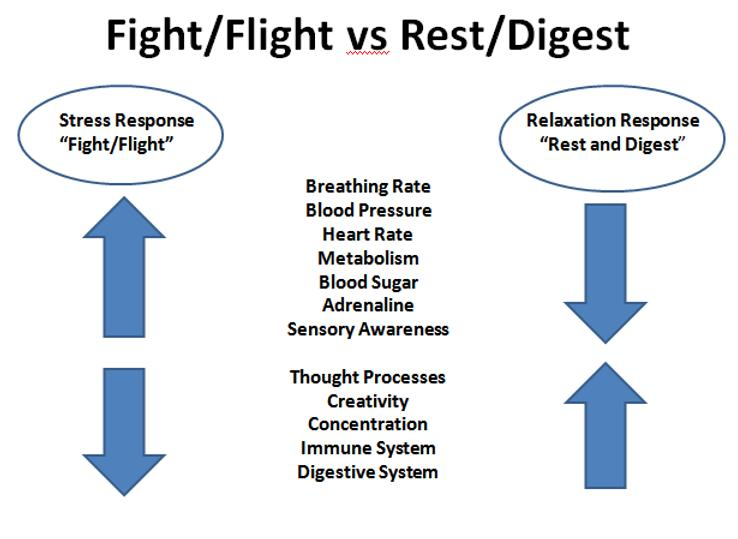
Sympathetic Division
Known as:
“Fight or Flight”
Effects:
- increases heart rate
- dilates pupils
- increases blood glucose
Parasympathetic Division
Known as:
“Rest and Digest”
Effects:
- slows heart rate
- promotes digestion
- conserves energy
Comparison Table
| Sympathetic | Parasympathetic |
|---|---|
| Stress response | Relaxation |
| Increases heart rate | Decreases heart rate |
| Inhibits digestion | Stimulates digestion |
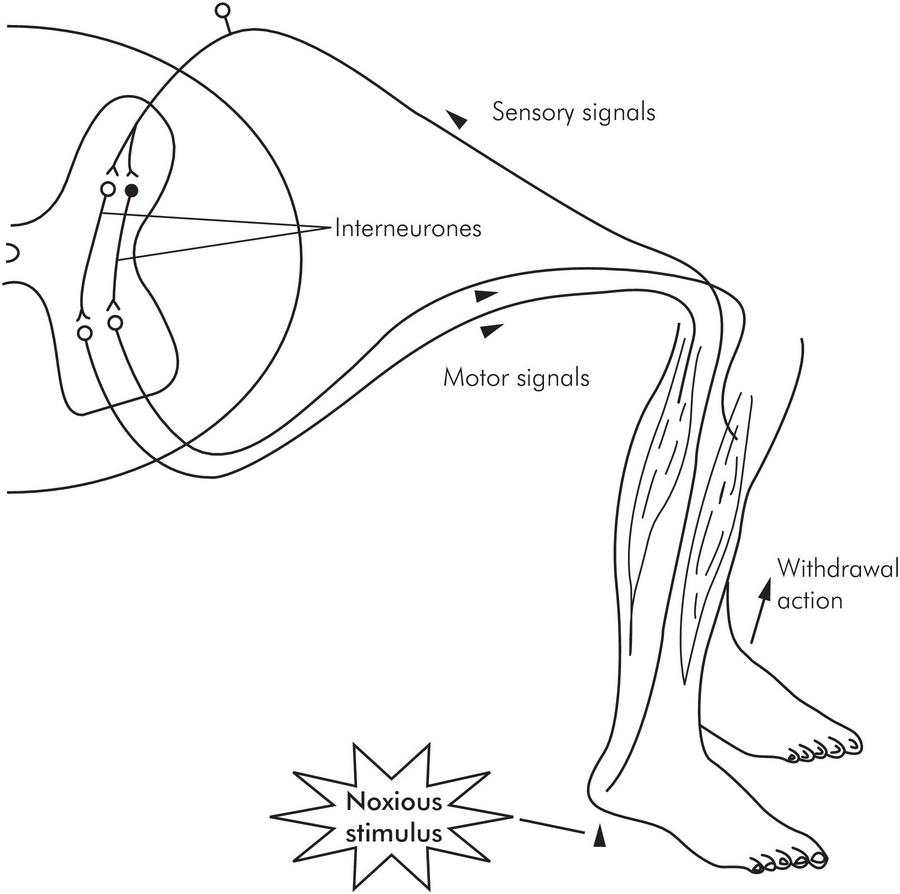
8- Reflexes
A reflex is a rapid, automatic response to a stimulus.
Example:
Touching a hot object.
Reflex Arc Components
- Receptor
- Sensory neuron
- Integration center
- Motor neuron
- Effector
Reflexes protect the body from injury.
8- Sensory and Motor Pathways
The nervous system contains two major pathways.
Sensory (Afferent) Pathways
Carry information toward the CNS.
Examples:
- touch
- pain
- temperature
Motor (Efferent) Pathways
Carry commands away from the CNS.
Examples:
- muscle contraction
- gland secretion
9- Protection of the Nervous System
The nervous system requires extensive protection.
Skull
Protects the brain.
Vertebral Column
Protects the spinal cord.
Meninges
Three protective membranes:
- dura mater
- arachnoid mater
- pia mater
Cerebrospinal Fluid (CSF)
Functions:
- cushioning
- nutrient transport
- waste removal
Blood-Brain Barrier
A specialized barrier that protects brain tissue from harmful substances.
10- Clinical Relevance
Understanding nervous system anatomy and physiology is crucial for medicine.
Stroke
Occurs when blood flow to brain tissue is interrupted.
Symptoms may include:
- weakness
- speech difficulties
- vision problems
Parkinson’s Disease
Associated with dopamine-producing neuron loss.
Symptoms:
- tremors
- rigidity
- slow movement
Multiple Sclerosis
An autoimmune disease affecting myelin.
Results in:
- impaired nerve conduction
- muscle weakness
- sensory deficits
Alzheimer’s Disease
Progressive neurodegenerative disorder causing memory loss.
11- Practical Examples
Example 1: Touching a Hot Stove
Sequence:
- receptors detect heat
- sensory neurons transmit signal
- spinal cord processes reflex
- motor neurons activate muscles
- hand withdraws
Example 2: Riding a Bicycle
Systems involved:
- cerebellum
- visual system
- vestibular system
- skeletal muscles
Example 3: Exam Stress
Sympathetic nervous system activation:
- increased heart rate
- sweating
- heightened alertness
12- Summary Points
- The nervous system is the body’s communication network.
- It consists of the CNS and PNS.
- Neurons transmit information.
- Glial cells support neurons.
- Synapses allow communication between cells.
- Neurotransmitters carry chemical messages.
- The autonomic nervous system regulates involuntary functions.
- Reflexes provide rapid protection.
- Brain and spinal cord coordinate body activities.
Conclusion
The nervous system is the body’s master control and communication network. Through a complex organization of neurons, glial cells, nerves, and brain structures, it coordinates nearly every activity necessary for survival. From simple reflexes to advanced reasoning and memory, the nervous system allows humans to interact with the environment, maintain homeostasis, and perform complex behaviors.
Understanding both the anatomy and physiology of the nervous system provides a strong foundation for studying medicine, neuroscience, biomedical engineering, and clinical healthcare. By connecting structure with function, students can better understand how the nervous system supports life and how neurological diseases develop when these systems are disrupted.
- Nervous system = communication and control network.
- CNS = brain + spinal cord.
- PNS = nerves outside CNS.
- Neurons are the functional units.
- Dendrites receive signals; axons send signals.
- Myelin increases conduction speed.
- Synapses allow neuron-to-neuron communication.
- Neurotransmitters carry chemical messages.
- Sympathetic = fight or flight.
- Parasympathetic = rest and digest.
- Reflexes provide automatic protection.
- The nervous system works with every other body system.
References
- Hall, J. E. (2020). Guyton and Hall Textbook of Medical Physiology (14th ed.). Elsevier. https://www.elsevier.com/books/guyton-and-hall-textbook-of-medical-physiology/hall/978-0-323-59712-8
- Standring, S. (2020). Gray’s Anatomy: The Anatomical Basis of Clinical Practice (42nd ed.). Elsevier. https://www.elsevier.com/books/grays-anatomy/standring/978-0-7020-7707-4
- Purves, D., Augustine, G. J., Fitzpatrick, D., et al. (2018). Neuroscience (6th ed.). Oxford University Press. https://global.oup.com/academic/product/neuroscience-9781605353809
- National Center for Biotechnology Information (NCBI Bookshelf). Neuroanatomy and Neurophysiology Resources. https://www.ncbi.nlm.nih.gov/books/
- National Institute of Neurological Disorders and Stroke (NINDS), NIH. https://www.ninds.nih.gov
- OpenStax. Anatomy and Physiology 2e. Rice University. https://openstax.org/details/books/anatomy-and-physiology-2e
- Encyclopaedia Britannica. Human Nervous System. https://www.britannica.com/science/human-nervous-system
- Cleveland Clinic. Nervous System Overview. https://my.clevelandclinic.org/health/body/21202-nervous-system
- Mayo Clinic. Brain and Nervous System Health. https://www.mayoclinic.org
- Kandel, E. R., Koester, J. D., Mack, S. H., & Siegelbaum, S. A. (2021). Principles of Neural Science (6th ed.). McGraw-Hill. https://www.mhprofessional.com/principles-of-neural-science-sixth-edition-9781259642236-usa