Why Do Hydrogels Swell Without Dissolving? Crosslink Density, Mesh Size, and Biomedical Design
Introduction
A hydrogel can absorb water and expand while remaining a coherent solid. The engineering challenge is not simply to make a polymer absorb more liquid: it is to retain the right dimensions, mechanical response and molecular transport after the material reaches its hydrated working state. Hydrogels are used in drug delivery, wound dressings, contact lenses and tissue-engineering systems, but those applications do not share a single optimum water content or network structure.[1][2]
The central question is how a network can take up water without dissolving, and what changing that network does to device performance. Swelling, stiffness and transport are coupled, so adjusting one can move the others away from their targets. Understanding that coupling is more useful than classifying every hydrogel as merely a “soft, biocompatible material.”
Table of Contents
- A Water-Filled Network, Not a Polymer Solution
- Why Swelling Stops
- Crosslink Density Changes More Than Stiffness
- Mesh Size Is Not the Same as Pore Size
- From Mesh Structure to Drug Transport
- What the Surrounding Fluid Changes
- Device Design: Choose the Working State First
- Sterilization Is Part of Material Design
- A Practical Characterization Plan
- Key Takeaways
- References
A Water-Filled Network, Not a Polymer Solution
A hydrogel contains hydrophilic polymer chains connected into a three-dimensional network. Water occupies the hydrated network; the connectivity prevents individual chains from simply separating and dispersing as they would in a polymer solution.[1]
The connections can be chemical crosslinks, such as covalent bonds, or physical junctions, such as reversible associations. These are not interchangeable design choices: a network whose junctions rearrange or dissociate can behave differently from a permanently linked network, especially when the surrounding conditions change.[1][2]
“Does not dissolve” therefore describes the network under specified conditions, not an unlimited lifetime guarantee. If the junctions or backbone break, network integrity can be lost. This is distinct from initial water uptake and connects to the difference between chemical degradation and physical mass loss discussed in our article on how resorbable implants disappear.
Why Swelling Stops
For a neutral, stable network in a compatible solvent, equilibrium swelling can be understood as a competition between two contributions:
- Polymer–water mixing favors uptake under favorable solvent conditions.
- Network elasticity resists the extension of chains as the network expands.[3]
The balance is commonly described through the Flory-based framework of polymer mixing and network elasticity. At equilibrium, adding more water no longer lowers the total free energy; equivalently, the solvent chemical potential is balanced with the surrounding bath. This is more accurate than saying that a hydrogel becomes “full” because all its holes have filled.[3]
Equilibrium is not instantaneous
An equilibrium swelling measurement describes the final state in a specified bath. It does not, by itself, tell an engineer how quickly a device will reach that state. A device specification should distinguish how much it changes from how long that change takes. For example, dimension measurements at one arbitrarily chosen immersion time should not be labeled equilibrium unless the dimensions or mass have stabilized.
This is an experimental design consequence of the distinction between a final-state model and a time-dependent measurement, not a claim that every hydrogel follows the same swelling kinetics.
One useful measurement equation
A common mass-based swelling measure can be written as:
Qₘ = mₛ / m_d
Here mₛ is the equilibrated swollen mass and m_d is the dry polymer-network mass. With consistent preparation and removal of superficial liquid, this ratio describes how much total hydrated mass corresponds to a unit of dry network. A related convention reports water uptake as (mₛ − m_d) / m_d. These numbers differ by one, so the equation must accompany the value.[1]
Neither mass ratio is automatically a volume ratio. Converting to polymer volume fraction requires an appropriate density relationship and clearly defined material states. If a formulation contains leachable components, changes in dry mass also need to be accounted for rather than attributed entirely to swelling.[3]
Crosslink Density Changes More Than Stiffness
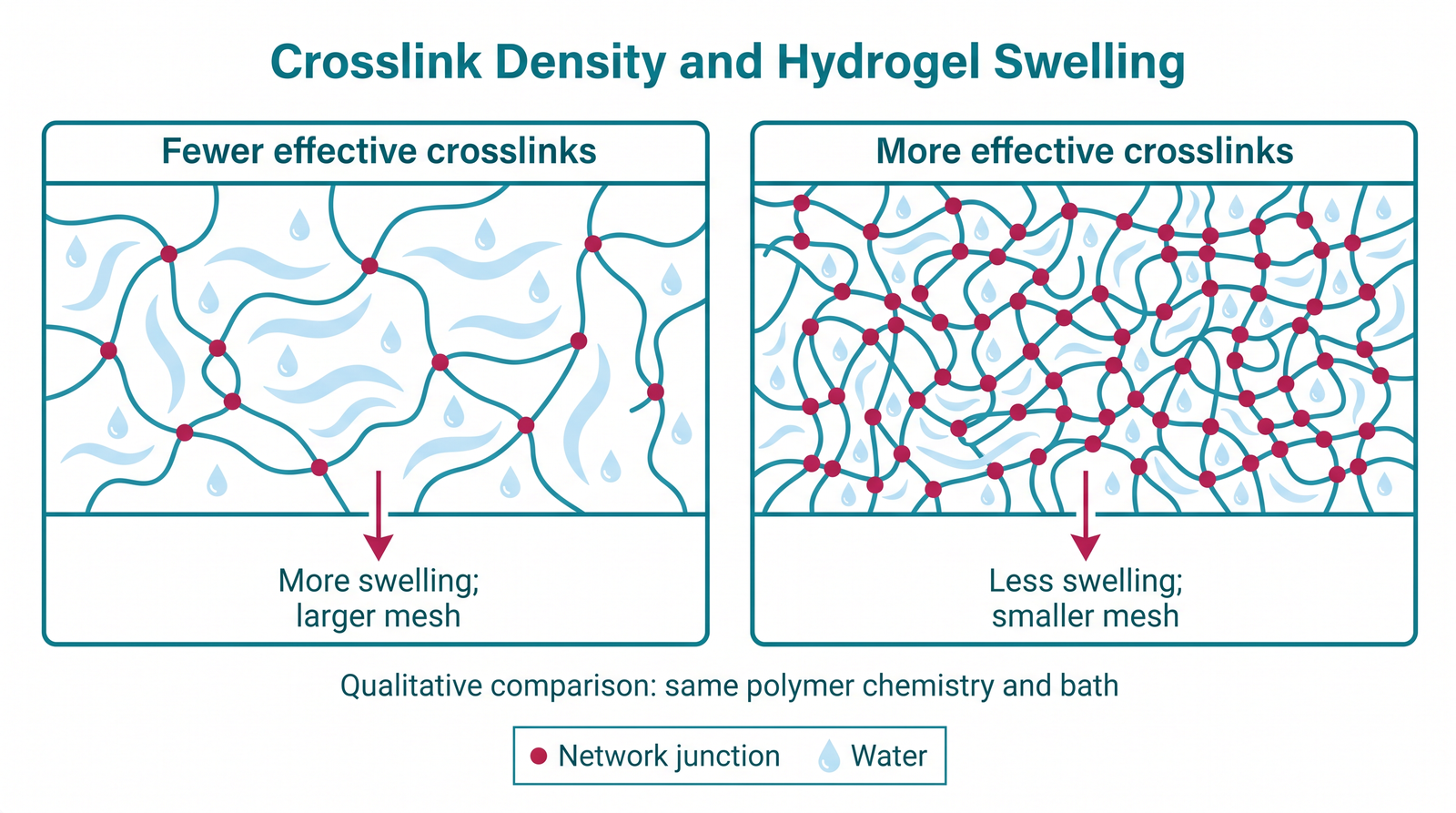
For otherwise comparable networks, increasing effective crosslinking generally constrains chain expansion, reduces equilibrium swelling and produces a tighter network. Reducing crosslinking generally allows more expansion. These trends link network formation to both mechanical and transport properties.[1][4]
The word effective matters. A recipe specifies amounts of polymer and crosslinking reagents, but the finished network can also contain chain-end defects and variation in junction connectivity. Formulation and load-bearing network structure are therefore related, not identical.[3][4]
A 2021 experimental study by Richbourg and colleagues connected synthesis conditions and swelling in synthetic PEG and PVA systems. Importantly, the same simple synthesis–swelling relationships did not transfer unchanged to the more complex gelatin-based networks examined in that study. That is a useful warning against turning a trend observed in one polymer family into a universal design equation.[4]
Stiffer is not automatically stronger or tougher
Small-deformation stiffness, resistance to fracture and energy dissipation answer different questions. A measured stiffness increase does not itself establish better handling, tear resistance or cyclic durability. These should be separate acceptance tests when the intended application requires them.
Likewise, a network optimized for mechanical support may not give the desired release profile. The correct decision is to characterize mechanics and transport together, rather than selecting the stiffest sample and assuming the rest of its performance will follow.[4][5]
Mesh Size Is Not the Same as Pore Size
Mesh size is a molecular-network descriptor associated with the spacing of connected network junctions and the chains between them. It is an average structural quantity, not a single rigid opening repeated throughout a real gel. Mesh-transport models can also distinguish mesh size from a geometrically defined mesh radius, because connectivity and three-dimensional geometry affect how a solute can pass through a network.[5]
Pore size, in contrast, may describe distinct cavities or channels in a porous hydrogel. Not every hydrogel has well-defined, interconnected pores of this kind. Molecular transport can occur through hydrated interstitial regions even when the gel does not resemble a sponge with visible holes.[1]
The practical rule is to label what was actually measured. A pore dimension from an image, a model-inferred average mesh size and a measured molecular diffusivity are different outputs; none should silently substitute for another. A characterization report should state whether it describes the working hydrated network or a differently prepared specimen.
Why a mesh is not a perfect sieve
Chains fluctuate, openings vary, and solute shape matters. A mean mesh value therefore does not create a perfectly sharp molecular cutoff. Transport models that treat solutes as approximately spherical, noninteracting particles are useful within their assumptions, but become less reliable for strongly interacting or nonspherical molecules.[5]
From Mesh Structure to Drug Transport
For a molecule moving through a hydrogel, the relevant questions are not just “how large are the spaces?” but also:
- How large and what shape is the solute in solution?
- How much of the swollen volume is occupied by polymer?
- Does the molecule interact with the network?
- Does the network stay unchanged during the test?[5]
A small, weakly interacting solute can experience less steric restriction than a larger one in the same network. But charge, affinity and partitioning can modify that simple picture. A diffusion-only model that excludes polymer–solute interactions should not be used to predict binding-controlled release without an additional treatment of those interactions.[5]
Diffusivity and release are not synonyms
Diffusivity describes how a solute spreads in a defined material state. Release describes transfer from an entire loaded construct into its surroundings. Release also depends on geometry, loading distribution, partitioning and whether swelling or degradation changes the network over time. This is why drug-delivery reviews distinguish multiple hydrogel architectures and release strategies rather than assigning every gel one release constant.[1][2][5]
For an engineering project, measure the intended payload wherever feasible. A convenient fluorescent tracer can establish a method or screen formulations, but a result for that tracer is not direct evidence of the transport behavior of a different drug or protein.
What the Surrounding Fluid Changes
A hydrogel property is a property of a material in an environment, not of its dry recipe alone. Polymer–solvent interactions and temperature enter the interpretation of swelling, while ionizable networks can respond to pH and ionic conditions.[1][3]
For example, the 2023 review describes acrylic-acid-containing copolymer hydrogels whose ionization in basic conditions promotes swelling. This is a formulation-specific mechanism, not a rule that every gel expands as pH rises.[1]
Charged networks require more than the simplest neutral-network mixing-plus-elasticity description; ionic contributions may need to be included. Conversely, a neutral-network model should not be made to look universal by hiding ionic effects inside a fitted parameter.[3]
Design consequence: swelling in pure water is useful as a controlled comparison, but it does not establish dimensions or transport in the intended biological fluid. Define the bath composition and temperature relevant to the intended use, and test in that state.
Device Design: Choose the Working State First
The following are engineering questions, not universal prescriptions for a particular polymer:
| Application | Network-related requirement | What must be checked alongside it |
|---|---|---|
| Drug-delivery depot | Suitable payload mobility and retention | Release in the intended medium, payload integrity and dimensional change |
| Wound dressing | Fluid uptake appropriate to the use | Wet integrity, handling and retention under the intended conditions |
| Hydrogel coating | Hydrated dimensions compatible with its substrate | Adhesion and dimensional change after hydration and processing |
| Tissue-engineering construct | Transport compatible with its biological purpose | Mechanical response and suitability of the finished formulation |
These application classes are well established in hydrogel literature, but a class name does not establish that an individual formulation has passed its performance tests.[1][2][6]
Do not infer biological suitability from water content
Hydrophilicity and softness do not prove safety. Biological evaluation concerns the actual finished formulation, including its chemistry and processing history. This follows the same context-dependent reasoning explained in our article on what biocompatibility actually means, rather than treating “hydrogel” as a safety certification.
Include time-dependent mechanics when relevant
A swollen construct may need to carry or transmit load over time. In that case, a single stiffness measurement is only part of the specification. Our article on creep, stress relaxation and hysteresis explains the experiments that distinguish an initial response from a sustained one. Whether those tests are needed depends on the intended device function.
Sterilization Is Part of Material Design
Hydrogels can be sensitive to terminal sterilization because of their polymeric structure and high water content. A 2023 review examines heat, radiation and gas methods, as well as emerging approaches, and identifies preserving functional properties as a central development challenge.[6]
The engineering implication is straightforward: characterize the material after the intended processing sequence, not only before it. A formulation that meets swelling and mechanical targets before sterilization has not yet demonstrated those properties in its finished state.
There is no universally best sterilization method for all hydrogels. The suitable approach must preserve the required function and be evaluated for the specific formulation and product. This article does not prescribe a sterilization cycle or claim compliance with any particular standard.[6]
A Practical Characterization Plan
Start with the device requirements, then use a linked set of measurements:
- Define the reference states. Record whether the starting material is dry, as-prepared or prehydrated, and document bath composition and temperature.
- Measure swelling over time. Report the equation used, demonstrate stabilization where equilibrium is claimed, and measure dimensions as well as mass when fit matters.
- Characterize working-state mechanics. Use the relevant load mode and timescale; avoid substituting dry-state behavior for hydrated behavior.
- Measure transport with a relevant solute. State the model assumptions and distinguish diffusivity from whole-device release.
- Repeat after processing. Check that sterilization and storage have not moved the material outside its specified property window.
- Assess the finished formulation. Evaluate biological suitability separately from physical resemblance to tissue.
This plan is an engineering synthesis of the coupled swelling, transport and processing issues covered in the sources, not a regulatory test standard.[1][3][4][5][6]
A useful acceptance criterion is not “maximum swelling.” It is a documented window of hydrated dimensions, mechanics and transport that the finished product can reproducibly achieve.
Key Takeaways
- Network connectivity lets a hydrogel absorb water while retaining a solid structure; that integrity depends on the network remaining stable under the specified conditions.
- Equilibrium swelling balances polymer–solvent mixing and network elasticity in the simplest neutral-network description. Charged or responsive networks may need additional terms.
- Effective crosslink density couples swelling to mechanical response and transport; a formulation ratio alone does not completely describe the finished network.
- Molecular mesh size, distinct pore dimensions and measured diffusivity are different quantities. Report the actual measurement and its material state.
- Mesh restriction is only one part of payload release. Solute interactions, partitioning, geometry and a changing network can also matter.
- Design and test the hydrated, processed working state. The most water-absorbing sample is not automatically the most useful biomedical device material.
References
- Thang NH, Chien TB, Cuong DX. Polymer-Based Hydrogels Applied in Drug Delivery: An Overview. Gels. 2023;9:523. https://doi.org/10.3390/gels9070523 — full text: https://europepmc.org/articles/PMC10379988
- Liu B, Chen K. Advances in Hydrogel-Based Drug Delivery Systems. Gels. 2024;10:262. https://doi.org/10.3390/gels10040262
- Hydrogel Design, Richbourg Lab. Equilibrium Swelling Theory. Educational treatment of the Flory-based polymer-mixing/network-elasticity balance, model assumptions and extensions. https://hydrogeldesign.org/the-model/equilibrium-swelling-theory/ — accessed 1 October 2026.
- Richbourg NR et al. Precise control of synthetic hydrogel network structure via linear, independent synthesis-swelling relationships. Science Advances. 2021. https://doi.org/10.1126/sciadv.abe3245
- Hydrogel Design, Richbourg Lab. Mesh Transport Theory. Educational treatment of mesh geometry, solute diffusion and model limitations; page updated 15 July 2026. https://hydrogeldesign.org/the-model/mesh-transport/ — accessed 1 October 2026.
- Bento et al. A review of conventional and emerging technologies for hydrogels sterilization. International Journal of Pharmaceutics. 2023. https://doi.org/10.1016/j.ijpharm.2023.122671