Why Is an Artery Not a Simple Spring? Elastin, Collagen, Compliance, and Vascular Graft Design
Introduction
Every heartbeat pushes a pulse of blood into the aorta, and the vessel wall does more than contain it. Large elastic arteries expand during systole and recoil afterward, buffering pressure oscillations and helping to propel blood toward the periphery. This buffering role is known as the Windkessel effect, and it depends on arterial compliance.[1]
For a biomedical engineer, the consequence is direct: a vascular graft or stent is not only a tube that must stay open and leak-free. It also becomes part of a pulsatile mechanical system. This article asks why arterial wall mechanics are nonlinear, what compliance really measures, and what changes when a stiff prosthesis replaces a compliant artery.
Table of Contents
- The Artery as a Pulsatile Buffer
- Why the Wall Is Nonlinear
- Compliance, Distensibility, and Stiffness Are Different Things
- Material Stiffness Versus Structural Stiffness
- What Happens When a Stiff Graft Replaces the Aorta
- Design Lesson: Copy the Behavior, Not Just the Material
- Testing Prostheses: Measure More Than One Condition
- Common Misconceptions
- Key Takeaways
- References
The Artery as a Pulsatile Buffer
The medial layer of a large elastic artery contains a network of elastin fibers, stiffer collagen fibers and smooth muscle cells.[1] During the cardiac cycle, the wall must accommodate changing pressure without behaving like a rigid pipe.
Compliance is what allows the aorta to buffer pressure oscillations. When compliance is lost, the cardiovascular system experiences a different hemodynamic load; the 2023 paper cited here describes reduced arterial compliance as associated with augmented systolic and pulse pressure and with downstream cardiovascular complications.[1] Those effects are the reason compliance is treated as a design-relevant property rather than a cosmetic one.
Where is the compliance?
The same paper reports that approximately 60% of total arterial compliance resides in the proximal aorta.[1] This does not mean that every artery contributes equally, or that the exact fraction applies to every individual. It does explain why replacing a section of large central artery can have an effect larger than its length alone might suggest.
Why the Wall Is Nonlinear
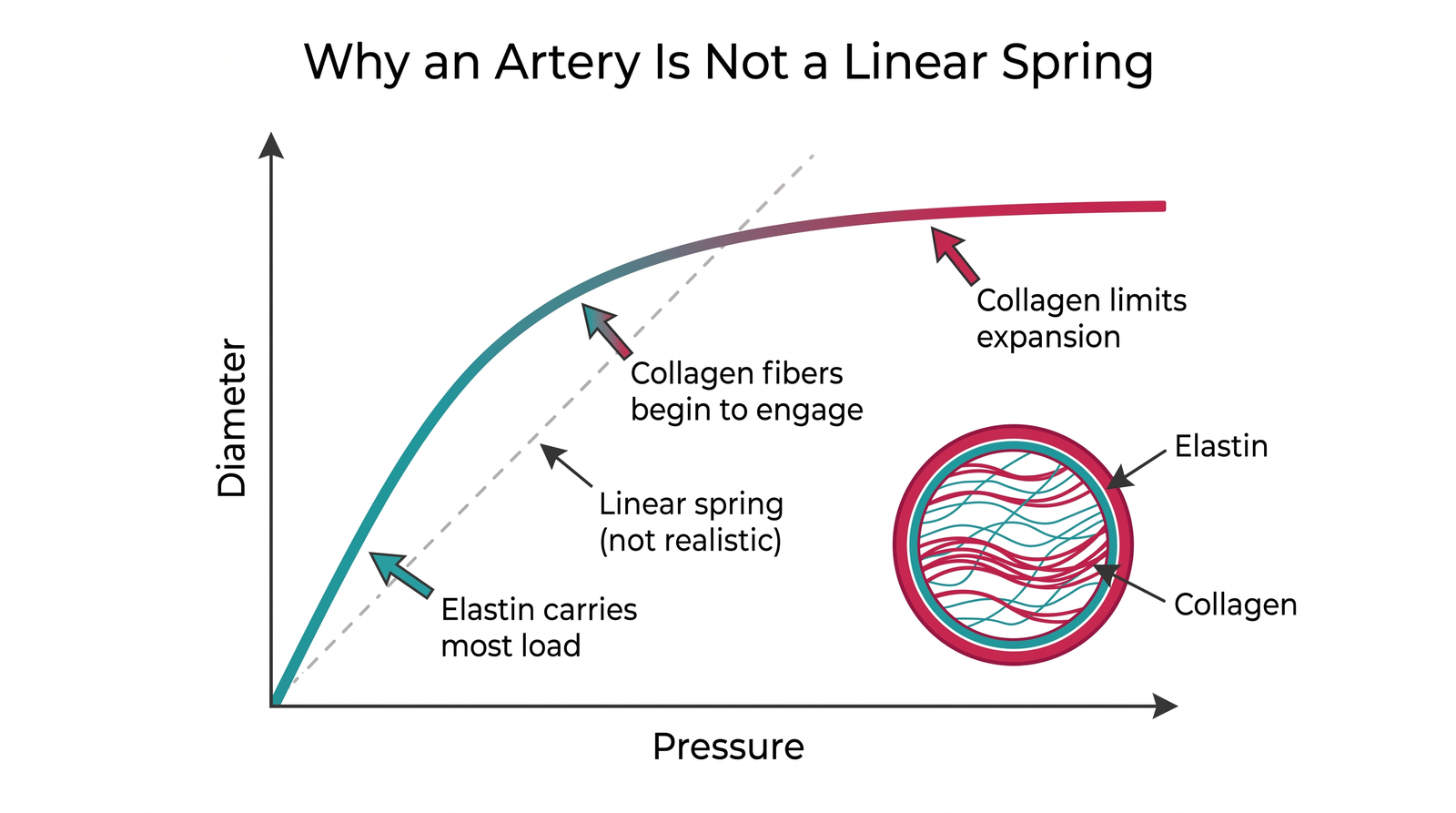
In an unloaded artery, both elastin and collagen fibers are undulated and wavy. At physiological pressure, the elastin fibers are largely straightened out and the collagen fibers are only partially engaged.[1] This gives the wall adequate elasticity at normal conditions and strength reserve at higher pressure.
That sequence of fiber recruitment produces a pressure-diameter curve that is not a straight line. A small change in pressure does not always produce the same change in diameter, so a single stiffness number is incomplete unless the pressure state is stated.
The figure is qualitative: it shows the mechanism, not measured values from any specific vessel. The same logic—soft response first, stiffening as fibers straighten—appears in soft-tissue mechanics generally, as discussed in our article on why soft tissue does not behave like a spring.
Pressure dependence is part of the property
The paper’s graft testing also illustrates that distensibility depends on pressure: a native-like response is not monotonic with pressure, because collagen initially unfolds and then begins to bear load, whereas a conventional woven polyester graft showed a monotonic loss of distensibility as pressure increased.[1] Evaluating a vascular device at a single pressure can therefore hide the way it behaves across the cardiac cycle.
Compliance, Distensibility, and Stiffness Are Different Things
These terms are often mixed together, but they answer different questions.
| Quantity | What it describes | Engineering warning |
|---|---|---|
| Compliance | How much a vessel segment changes volume for a pressure change | Depends on geometry and pressure state |
| Distensibility | Relative change in the vessel’s size per unit pressure; used in the cited study as mmHg⁻¹ | Specify the reference pressure and test conditions |
| Incremental elastic modulus | A material-level stiffness at a given loading state | Does not by itself describe the whole structure |
| Pulse wave velocity | A wave-speed measure related to vessel compliance | Depends on wall properties and geometry, so interpret with context |
Because several of these are pressure-dependent, a table of “vessel stiffness” without a loading state is not a design specification. The 2023 study reports distensibility at a stated reference pressure and under stated implantation conditions, which is the kind of specification a device engineer should require.[1]
Material Stiffness Versus Structural Stiffness
The Moens–Korteweg equation relates pulse wave velocity to the incremental elastic modulus, wall thickness, vessel radius and blood density. The source uses it to separate material stiffness, defined by the incremental elastic modulus, from structural stiffness, defined by the product of modulus and wall thickness.[1]
That distinction explains an apparently counterintuitive point made in the paper: a thin metallic tube can be more compliant than a thicker plastic one even though the metal’s elastic modulus is much higher.[1] The mechanical response of a construction depends on its shape and architecture, not on its constituent material alone.
For a device designer, the practical consequence is to ask two separate questions: What is the material? and How is that material arranged? A stiff material in a deformable architecture can behave very differently from the same material in a continuous thick-walled tube. This is a structure–property lesson that also underlies the choices discussed in our overview of biomaterials in biomedical engineering.
What Happens When a Stiff Graft Replaces the Aorta
The 2023 paper notes that major improvements have been made in synthetic grafts for large arteries to ease application and shorten operation time, but little has been done to address their inability to mimic native aortic elastomechanical properties.[1] It describes synthetic grafts that can be many times stiffer than native tissue and therefore decrease aortic compliance substantially, which in turn reduces total arterial compliance.[1]
It also reports that some frequent graft complications, including rupture, migration, endoleak, infection and restenosis, could be partially attributed to the abrupt change of properties between graft and artery.[1] The word “partially” matters. Compliance mismatch is one mechanism to consider, not a complete explanation for every graft failure.
Mismatch happens at two scales
- System scale: the graft changes how the arterial tree buffers pulsatile pressure.
- Interface scale: an abrupt property change can create a mechanical discontinuity where the prosthesis meets the vessel.[1]
A design review should therefore consider both the prosthesis in isolation and the transition to the surrounding tissue.
Design Lesson: Copy the Behavior, Not Just the Material
The authors of the study took inspiration from the layered structure of large elastic arteries to create a compliance-matching graft. The inner layer was a stiff woven graft equivalent to those used in clinical practice. An outer, easily deformable z-shaped stent compressed the inner layer circumferentially, giving the woven fibers margin to uncoil before they became engaged.[1]
In that design, the stiff graft played the role of collagen by providing strength, while the deformable stent played the role of elastin by controlling radial expansion and overall compliance.[1] The important design idea is not that every future graft should copy this exact configuration. It is that a load-engagement sequence can be engineered into a structure.
Reported computational and experimental results illustrate the point:
- A radial compression of 10%–15% was enough to increase compliance without excessive folding of the inner layer.
- The optimized compliance-matching grafts reached a distensibility of 1.60 × 10⁻³ mmHg⁻¹ (SD 0.17 × 10⁻³) at 100 mmHg reference pressure under the stated implantation conditions: body temperature and 10% longitudinal prestretch.
- A 10% longitudinal prestretch reduced distensibility by 9% for compliant grafts and 56% for PET grafts.[1]
These numbers belong to that specific study and its tested conditions. They are not general acceptance limits for vascular grafts.
Testing Prostheses: Measure More Than One Condition
The prestretch and temperature results are a useful reminder that a bench result is conditional. In the same study, increasing temperature raised the maximum distensibility of both graft types in the 80–140 mmHg range, and the compliance-matching grafts showed a larger increase than the PET grafts.[1]
A defensible vascular-device characterization plan therefore specifies:
- Pressure range, not a single pressure.
- Temperature, relevant to the implanted state.
- Axial prestretch, because implantation can change the mechanical state.
- Diameter and geometry, because structure affects compliance.
- Interface behavior, including the transition to native tissue.
The source also states that validated models for predicting pressure-dependent properties of vascular prostheses are notably absent in the literature, although finite-element simulations of fiber-based grafts and stents have produced accurate results in some cases.[1] Treat any computational prediction as something to be validated against the intended device and conditions.
Common Misconceptions
- “Stiffer is stronger, so stiffer is better.” Strength and compliance are different requirements; the mechanism of fiber recruitment shows why an artery has both.
- “A high modulus material must create a stiff structure.” Structural stiffness also depends on geometry and architecture.
- “Compliance is one number.” It is condition-dependent; pressure, temperature and prestretch can change the result.
- “Compliance mismatch explains every graft complication.” The source frames it as a possible partial contributor.
Key Takeaways
- Large elastic arteries buffer pulsatile pressure through compliance, the basis of the Windkessel effect.
- Arterial nonlinearity arises from fiber recruitment: elastin and collagen engage differently as pressure changes.
- Compliance, distensibility, material modulus and structural stiffness are related but not interchangeable.
- A thin, deformable architecture can be more compliant than a thicker construction made from a softer material.
- A stiff graft can reduce aortic compliance and add an abrupt property change at the graft–artery interface.
- Vascular prosthesis testing should specify pressure range, temperature, prestretch and geometry.
- Numerical results from one study are evidence about that design and test setup, not universal device limits.
References
- Rovas G, Bikia V, Stergiopulos N. Design and computational optimization of compliance-matching aortic grafts. Frontiers in Bioengineering and Biotechnology. 2023;11:1179174. https://doi.org/10.3389/fbioe.2023.1179174 — full text read: https://www.frontiersin.org/journals/bioengineering-and-biotechnology/articles/10.3389/fbioe.2023.1179174/full