
The DEXA Scanner for Biomedical Engineers: Principles, Components, Clinical Applications, and Emerging Innovations
The DEXA Scanner — short for Dual Energy X-ray Absorptiometry — is one of the most clinically significant imaging tools in the biomedical field. Since its development in the late 1980s, it has become the undisputed gold standard for measuring bone mineral density (BMD) and diagnosing osteoporosis. For biomedical engineers, understanding the physics, hardware architecture, software integration, and regulatory requirements of a DEXA system is essential — whether you are involved in design, procurement, maintenance, or quality assurance. If you are new to radiological imaging in general, we recommend first reading our article on Radiological Devices: All You Must Know as a Biomedical Engineer before diving into the specifics covered here.

- What is a DEXA Scanner?
- Why is a DEXA Scanner Used?
- How Does a DEXA Scanner Work in General?
- What Are the Main Components of a DEXA Scanner?
- What Types/Variants of DEXA Scanners Exist?
- What Are the Main Benefits of a DEXA Scanner?
- What Are the General Risks or Limitations?
- How is the DEXA Scanner Evolving? Recent Innovations
- Key Takeaways / Tips for Biomedical Engineers
1. What is a DEXA Scanner?
Definition and Historical Background
DEXA stands for Dual Energy X-ray Absorptiometry. It is a medical imaging modality that uses two distinct X-ray energy levels — typically a low energy beam around 40–47 keV and a high energy beam around 70–100 keV — to measure the density and mineral content of bone tissue. The system was developed in the late 1980s, replacing earlier single-energy photon absorptiometry techniques, and quickly established itself as the gold standard for bone mineral density (BMD) measurement and osteoporosis diagnosis. The dual-energy approach was a breakthrough because it enabled clinicians to mathematically separate the contributions of bone mineral from overlying soft tissue, dramatically improving measurement accuracy and repeatability.
Clinical Context and Relevance
Osteoporosis is a skeletal disease affecting hundreds of millions of people worldwide, particularly postmenopausal women and the elderly. It is characterized by reduced bone mass and deteriorated bone microarchitecture, increasing fracture risk. Prior to DEXA, accurate, non-invasive BMD measurement was difficult. DEXA changed this by providing a fast, reproducible, low-dose method for quantifying BMD at clinically important skeletal sites such as the lumbar spine, femoral neck, and total hip. Today, DEXA is also widely used for whole-body composition analysis — measuring fat mass, lean mass, and bone mineral content — making it a versatile tool far beyond its original osteoporosis application. For biomedical engineers, understanding DEXA’s clinical purpose is the first step toward appreciating its engineering design.
2. Why is a DEXA Scanner Used?
Bone Mineral Density Assessment and Osteoporosis Screening
The primary clinical indication for DEXA scanning is the assessment of bone mineral density (BMD) in patients at risk of osteoporosis or osteopenia. According to WHO criteria, a T-score of less than −2.5 (more than 2.5 standard deviations below the mean BMD of a young healthy reference population) is diagnostic for osteoporosis. A T-score between −1.0 and −2.5 indicates osteopenia, while a T-score above −1.0 is considered normal. DEXA also generates a Z-score, which compares the patient’s BMD to an age- and sex-matched reference population. A Z-score below −2.0 raises suspicion for secondary causes of bone loss, such as glucocorticoid therapy, malabsorption syndromes, or hyperparathyroidism. These standardized thresholds give clinicians a clear framework for diagnosis and treatment decisions, and make DEXA output highly interpretable and reproducible across institutions.
Body Composition and Research Applications
Beyond bone health, modern DEXA systems offer whole-body composition analysis, quantifying regional and total fat mass, lean mass, visceral fat area, and bone mineral content (BMC). These measurements are increasingly important in managing obesity, sarcopenia, metabolic syndrome, and cancer cachexia. Research applications include monitoring athletes’ body composition, studying age-related muscle loss, and evaluating the effects of pharmaceutical or dietary interventions. DEXA is also used in pediatric populations to track bone development and in patients undergoing long-term corticosteroid therapy. Integration with fracture risk tools like FRAX — which combines BMD with clinical risk factors to calculate 10-year fracture probability — makes DEXA an indispensable decision-support tool in modern musculoskeletal medicine and geriatric care.
3. How Does a DEXA Scanner Work in General?
The Physics of Dual-Energy Absorptiometry
The fundamental operating principle of DEXA is differential X-ray beam attenuation. When an X-ray beam passes through biological tissue, its intensity is attenuated exponentially according to the Beer-Lambert law: I(t) = I₀ × e−(μ/ρ)×t×ρ, where I₀ is the incident intensity, μ/ρ is the mass attenuation coefficient of the material, t is the thickness, and ρ is the density. Bone mineral (primarily hydroxyapatite) and soft tissue have very different mass attenuation coefficients, and these differences are energy-dependent. By acquiring simultaneous or rapidly alternated measurements at two distinct photon energies, the DEXA system can solve a system of two equations to independently calculate the areal density of bone mineral and soft tissue at each pixel in the image. This elegant mathematical approach is what makes DEXA far more accurate than single-energy methods.
Dual-Energy Generation Methods
There are two primary methods used by manufacturers to generate the two X-ray energy levels. The first is kVp switching (voltage switching), used by Hologic in its Horizon and Discovery series: the X-ray tube rapidly alternates between 70 kV and 140 kV, producing photon spectra at two different peak energies. The second method is K-edge filtration, used by GE Healthcare/Lunar in the iDXA and Prodigy systems: a rare-earth filter (cerium or samarium) is placed in the beam path, creating two energy peaks based on the K-edge absorption characteristics of the filter material. Both approaches produce a low-energy beam (~40–47 keV effective) and a high-energy beam (~70–100 keV effective). Each technique has its own trade-offs in terms of spectral separation, dose efficiency, and detector design — details that matter greatly to biomedical engineers performing acceptance testing or cross-calibration between systems.
Scan Geometry and Image Formation
The X-ray source and detector array are mounted on a C-arm gantry that translates across or around the patient. In fan-beam systems, a wide fan of X-rays covers a larger area simultaneously, enabling fast scanning (3–7 minutes for a lumbar spine or hip scan) with higher spatial resolution but at a slightly higher radiation dose. In older pencil-beam systems, a narrow collimated beam scans in a raster pattern, taking longer but delivering a lower dose. The energy-discriminating detector array — typically a multi-element scintillator or direct-conversion detector — measures transmitted intensity at each energy level for every pixel location. The onboard computer reconstructs a BMD map (g/cm²) by applying the dual-energy decomposition algorithm, and the analysis software identifies regions of interest (e.g., vertebral bodies L1–L4, femoral neck) to compute T-scores and Z-scores.
4. What Are the Main Components of a DEXA Scanner?
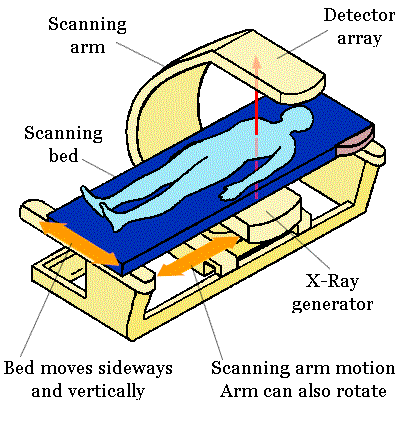
X-ray Tube, Generator, and Collimator
The X-ray tube is a rotating-anode or stationary-anode device designed for the relatively low power levels required by DEXA (compared to CT or conventional radiography). The high-voltage generator controls the kVp and mA settings, and in voltage-switching systems it must switch rapidly and accurately between two kVp values. The collimator shapes the X-ray beam into either a fan or pencil geometry, and pre-patient filtration may be applied to harden the beam or shape its spectrum for K-edge filtration systems. Beam alignment and calibration of the collimator assembly are critical quality control tasks, as any misalignment can introduce systematic errors in BMD measurements. Biomedical engineers should pay close attention to tube aging and output drift — regular calibration against a certified phantom is mandatory to detect these changes early.
Detector Array and C-arm Gantry
The detector system in a modern fan-beam DEXA is a multi-element array capable of energy discrimination — measuring the transmitted photon fluence at both low and high energies simultaneously or in rapid alternation. Common detector technologies include solid-state scintillator arrays (e.g., cadmium zinc telluride or gadolinium oxysulfide coupled to photodiodes). The C-arm gantry provides mechanical motion of the X-ray tube and detector in a synchronized scan trajectory over the patient. Precision of the mechanical drive system directly affects spatial accuracy of the BMD map. The motorized patient table must remain perfectly stable during scanning; any patient or table motion introduces artifacts and measurement errors. Routine preventive maintenance of the gantry drive motors, belts, and position encoders is a key responsibility for clinical biomedical engineers.
QC Phantom, Calibration, and DICOM Software
Every DEXA system is supplied with a manufacturer-specific quality control (QC) phantom — a calibration object with precisely known bone-equivalent densities. Daily scanning of this phantom, followed by Shewhart control chart analysis of the results, is mandated by ISCD (International Society for Clinical Densitometry) guidelines to detect drift, instability, or equipment failure before patient scans are affected. Cross-calibration phantoms (e.g., the European Spine Phantom) are used when comparing results across different DEXA systems or manufacturers. The DICOM-compatible analysis software receives raw detector data, applies the dual-energy algorithm, performs ROI identification (automated with manual override), computes BMD, T-scores, and Z-scores, and generates structured reports. Modern systems integrate FRAX fracture risk calculation and DICOM SR (Structured Reporting) for seamless PACS and EHR connectivity. Understanding this software architecture is increasingly important as explored in Top Skills Every Biomedical Engineer Should Master.
5. What Types/Variants of DEXA Scanners Exist?
Overview of DEXA System Types
DEXA scanners are broadly categorized by their scanning site and clinical application: Central DEXA systems measure BMD at the lumbar spine and proximal femur (hip), which are the WHO-referenced sites for osteoporosis diagnosis; Peripheral DEXA (pDXA) devices measure BMD at appendicular sites such as the forearm, wrist, or calcaneus; and Whole-body DXA systems perform full-body composition analysis in addition to BMD. Within central DEXA, the distinction between fan-beam and pencil-beam technology is also clinically and technically significant. The table below summarizes the key differences between the major DEXA system types currently available from leading manufacturers including Hologic (Horizon W, Discovery A/C/W), GE Healthcare/Lunar (iDXA, Prodigy Advance), and Norland (XR-800, Elite Plus).
| Feature | Central DEXA (Fan-beam) | Central DEXA (Pencil-beam) | Peripheral DEXA (pDXA) | Whole-body DXA |
|---|---|---|---|---|
| Scan Sites | Spine, hip | Spine, hip | Forearm, wrist, heel | Full body |
| Scan Time | 3–7 min | 10–20 min | 1–5 min | 6–10 min |
| Effective Dose | 3–10 μSv | 1–3 μSv | <1 μSv | 3–10 μSv |
| Resolution | High | Moderate | Moderate | High |
| Portability | Fixed/room-based | Fixed/room-based | Portable/compact | Fixed/room-based |
| Body Composition | Limited (with add-on) | No | No | Yes (full) |
| Example Models | Hologic Horizon W, GE iDXA | Norland XR-800 | GE PIXI, Osteometer DTX-200 | Hologic Discovery W, GE Prodigy |
Fan-beam vs Pencil-beam: Engineering Trade-offs
Fan-beam DEXA systems use a wide X-ray fan and a multi-element detector array to image a large field of view simultaneously, enabling scan times of 3–7 minutes for standard skeletal sites. The higher photon fluence and spatial resolution translate to better image quality and more precise ROI delineation, but at the cost of a slightly higher effective dose (3–10 μSv) and higher equipment complexity. The fan-beam geometry also introduces a modest magnification error that must be corrected by the software. Pencil-beam systems, by contrast, use a narrow collimated beam and a single detector in a raster scan pattern. They are slower (up to 20 minutes) but deliver a very low dose (1–3 μSv) and are mechanically simpler. Pencil-beam systems were the dominant technology until the mid-1990s; today they are less common in new installations but remain in use at many facilities. Biomedical engineers should be aware of these differences when evaluating scan protocols and performing acceptance tests.
6. What Are the Main Benefits of a DEXA Scanner?
Precision, Low Dose, and Non-invasiveness
DEXA’s most celebrated engineering achievement is the combination of high measurement precision with extremely low radiation exposure. The coefficient of variation (CV) for in vivo BMD measurements is typically less than 1.5% for lumbar spine and femoral neck measurements — an extraordinary level of reproducibility for a clinical measurement of a biological structure. The effective dose per examination is just 1–10 μSv, equivalent to a few hours of natural background radiation and orders of magnitude lower than a chest CT scan (~5,000 μSv). The procedure is entirely non-invasive and non-contact: the patient lies fully clothed on the table, and no injections, contrast agents, or special preparation are required. These characteristics make DEXA acceptable for serial monitoring — patients can be rescanned every 1–2 years to track BMD change in response to therapy — and for population screening programs.
Versatility and Clinical Utility
Modern DEXA systems offer a broad range of clinical applications within a single platform. Beyond BMD and T-score/Z-score reporting, whole-body DXA provides regional body composition data — fat mass, lean mass, visceral fat area, and BMC — that are clinically actionable in obesity management, sports medicine, and metabolic research. The same scan session can also include Vertebral Fracture Assessment (VFA), a low-dose lateral spine image that screens for vertebral deformities without a separate X-ray. FRAX integration allows the software to automatically compute 10-year fracture probability by combining BMD with clinical risk factors. As discussed in our article on Ethical Considerations in Biomedical Engineering, the ability of a single low-dose modality to provide this breadth of diagnostic information raises important questions about appropriate use, data privacy, and patient consent that biomedical engineers should be prepared to address.
7. What Are the General Risks or Limitations?
Measurement Errors and Confounding Factors
Despite its precision, DEXA is subject to several important sources of measurement error that biomedical engineers must understand. Patient positioning is a critical variable: small changes in leg rotation, arm placement, or lumbar lordosis can alter measured BMD by 1–5%. Metal implants — joint prostheses, vertebral hardware, surgical clips, dense clothing artifacts — severely distort local BMD values and can render a scan uninterpretable in that region. Degenerative changes such as osteophytes, aortic calcifications, or vertebral compression fractures artificially elevate lumbar spine BMD, potentially masking true bone loss in elderly patients. Body composition also affects accuracy: adipose tissue distribution, hydration state, and ascites can shift the tissue baseline used in the dual-energy decomposition algorithm. These confounders must be recognized and documented by the operator, and their impact understood by the engineer responsible for system calibration and software configuration.
Structural and Physical Limitations
DEXA is a two-dimensional (2D) projection technique applied to inherently three-dimensional (3D) structures. The reported BMD value (g/cm²) is an areal density, not a true volumetric density, which means it is influenced by bone size. Larger bones appear denser even if their volumetric BMD is identical to smaller bones — an important confounder in pediatric measurements, individuals with short stature, or vertebrae affected by scoliosis. DEXA also cannot directly distinguish trabecular bone from cortical bone, nor can it characterize bone microarchitecture beyond what is implied by TBS (Trabecular Bone Score) post-processing. Patient size is another physical constraint: most DEXA patient tables have a maximum weight limit of approximately 200 kg, limiting use in severely obese patients. Additionally, scan field of view in some systems may be insufficient for very wide or tall patients, requiring non-standard positioning protocols. As with all radiological devices, understanding these limitations is part of responsible engineering practice — an issue covered broadly in Radiological Devices: All You Must Know as a Biomedical Engineer.
8. How is the DEXA Scanner Evolving? Recent Innovations
AI Integration and Advanced Bone Analysis
Artificial intelligence is reshaping what DEXA systems can offer. Modern software platforms now incorporate machine learning algorithms for automated vertebral fracture detection, opportunistic BMD screening from routine CT datasets, and AI-powered fracture risk prediction models that go beyond the traditional T-score threshold. The Trabecular Bone Score (TBS) is a texture analysis algorithm applied to the lumbar spine DXA image that provides an indirect index of trabecular microarchitecture — a parameter DEXA cannot measure directly — and is now used alongside BMD to refine FRAX fracture probability estimates. Vertebral Fracture Assessment (VFA) has become standard on most central DEXA platforms, providing instant lateral spine imaging within the same scan session for vertebral deformity screening. These innovations extend the diagnostic value of each DEXA examination without adding significant dose or scan time, representing an important cost-efficiency gain for healthcare systems.
3D DXA, HD Body Composition, and Connectivity
3D DXA technology, exemplified by the 3D Shaper software platform, reconstructs a patient-specific 3D bone model from the 2D DXA projection using a statistical shape and appearance model. This approach yields volumetric BMD estimates and 3D geometric parameters (cortical thickness, cross-sectional area, section modulus) from a standard DXA scan without additional radiation — a significant advance over simple areal BMD. For body composition, HD (High-Definition) body composition software now provides automated segmentation of visceral fat from retroperitoneal fat in the trunk region, an important predictor of cardiometabolic risk that was previously only quantifiable by CT or MRI. DEXA systems are increasingly connected to hospital information systems via HL7 FHIR and DICOM SR, enabling seamless data flow into EHR platforms and population health analytics pipelines. For biomedical engineers, managing these software updates, data integration pathways, and cybersecurity requirements is an increasingly important domain of practice — directly related to the competencies described in Top Skills Every Biomedical Engineer Should Master.
9. Key Takeaways / Tips for Biomedical Engineers
Regulatory, Standards, and QC Framework
DEXA scanners are classified as Class II medical devices under FDA 21 CFR 892.5050 (bone densitometer), subject to 510(k) premarket notification requirements. Internationally, they must comply with IEC 60601-1 (general electrical safety for medical electrical equipment) and IEC 60601-1-3 (radiation protection requirements for diagnostic X-ray equipment). Quality management system requirements are governed by ISO 13485. Operational QC protocols are defined by ISCD guidelines: daily spine phantom scans, Shewhart control chart analysis with predefined action and warning limits, and periodic cross-calibration between systems. A thorough understanding of device classification is fundamental — as explored in How Biomedical Devices Are Classified — because classification determines the regulatory pathway, post-market surveillance requirements, and the level of engineering documentation needed throughout the device lifecycle.
Practical Tips for Engineers Working with DEXA
For biomedical engineers involved in the procurement, installation, acceptance testing, or maintenance of DEXA systems, here are the most important practical considerations: First, establish a rigorous QC program from day one — daily phantom scanning and trend analysis are non-negotiable and form the foundation of defensible clinical data. Second, understand the manufacturer-specific beam generation method (kVp switching vs. K-edge filtration) because it affects cross-calibration protocols when comparing results between systems from different vendors. Third, ensure X-ray shielding and radiation survey documentation are completed per local regulatory requirements before the first patient scan. Fourth, maintain detailed service logs and software version control records, as firmware and algorithm updates can shift absolute BMD values — any such changes must be communicated to clinical staff and documented in the QC record. Fifth, collaborate closely with clinical physicists and densitometry technologists; DEXA is one of the few imaging modalities where technologist skill and positioning technique have a measurable impact on diagnostic accuracy, and engineers play a key role in training infrastructure and equipment readiness.
Summary of Core Engineering Specifications
To summarize the key technical parameters a biomedical engineer should know: DEXA uses two X-ray energies (low ~40–47 keV, high ~70–100 keV) generated by either kVp switching or K-edge filtration; effective dose per exam is 1–10 μSv; scan times range from 3–7 minutes (fan-beam) to 10–20 minutes (pencil-beam); BMD precision (CV) is less than 1.5%; patient table weight limit is approximately 200 kg; output metrics include BMD (g/cm²), T-score, Z-score, and body composition parameters; and regulatory compliance requires IEC 60601-1, IEC 60601-1-3, FDA 21 CFR 892.5050, and ISO 13485 adherence. With AI-powered tools, 3D reconstruction, and advanced body composition analysis now standard features, DEXA remains one of the most clinically valuable and technically interesting devices in the biomedical engineer’s portfolio.
References
- Blake GM, Fogelman I. The role of DXA bone density scans in the diagnosis and treatment of osteoporosis. Postgrad Med J. 2007;83(982):509–517.
- Shepherd JA, Schousboe JT, Broy SB, et al. Executive Summary of the 2015 ISCD Position Development Conference on Advanced Measures From DXA and QCT. J Clin Densitom. 2015;18(3):265–271.
- World Health Organization. Assessment of fracture risk and its application to screening for postmenopausal osteoporosis. WHO Technical Report Series 843. Geneva: WHO; 1994.
- Hologic Inc. Horizon DXA System Technical Manual. Bedford, MA: Hologic; 2022.
- GE Healthcare. iDXA System User Guide. Madison, WI: GE Healthcare; 2021.
- International Society for Clinical Densitometry (ISCD). 2019 ISCD Official Positions — Adult. Middletown, CT: ISCD; 2019.
- IEC 60601-1-3:2008+AMD1:2013. Medical electrical equipment — Part 1-3: General requirements for basic safety and essential performance — Collateral standard: Radiation protection in diagnostic X-ray equipment. Geneva: IEC; 2013.
- FDA. 21 CFR Part 892.5050 — Bone densitometer. U.S. Food and Drug Administration; 2023.
- Kanis JA, Harvey NC, Johansson H, et al. Overview of Fracture Prediction Tools. J Clin Densitom. 2017;20(3):444–450.
- Engelke K. Quantitative CT and DXA Measurements of Bone: an Update. Ann Biomed Eng. 2017;45(4):954–971.
