What Does Biocompatibility Actually Mean in Biomaterials Engineering?
Introduction
Ask ten engineering students to define biocompatibility and most will answer something like “a material that is not harmful to the body.” That answer is not wrong, but it is not usable. It cannot tell you whether a polymer suitable for a 30-minute catheter is suitable for a 20-year implant, and it cannot tell you why the same alloy performs well as a hip stem yet triggers an aggressive cellular response once it becomes wear debris.
Biocompatibility is one of the few concepts in biomaterials that a designer meets on day one and keeps meeting until the device is on the market. Understanding it correctly changes how you select materials, how you plan testing, and how you read regulatory requirements.
Table of Contents
- What Is Biocompatibility?
- Why It Matters in Biomedical Engineering
- How the Host Responds
- What Determines the Response
- Contact Type and Duration: The ISO 10993-1 Framework
- How Biocompatibility Is Evaluated in Practice
- Limitations Engineers Should Understand
- Engineering Considerations
- Key Takeaways
- References
What Is Biocompatibility?
A widely used definition, articulated by David Williams, describes biocompatibility as the ability of a material to perform with an appropriate host response in a specific application.[1]
Two words in that definition carry most of the engineering weight:
- Appropriate — not “no response.” Every material placed in tissue provokes some biological response. The question is whether the response is acceptable for the intended function.
- Specific application — biocompatibility is defined for a use case, not for a material in isolation.
In simpler language: biocompatibility describes how well a material–body–application combination works together, not how “safe” a substance is on its own. This is why the phrase “biocompatible material” is technically imprecise. Williams and others have argued that biocompatibility must be framed as a set of mechanisms and pathways rather than as an intrinsic label, and later work extended this into a mechanism-based framework of biocompatibility pathways.[1][2]
Ratner made a similar argument, calling for biocompatibility to be defined by the biological outcome an engineer actually wants — for example healing and integration — rather than by the absence of obvious harm.[3] More recently, Williams described biocompatibility as “plastic”: the same material can produce different host responses depending on context, and modern applications such as tissue engineering and cell-based therapies deliberately aim for active biological responses rather than inert ones.[4]
Why It Matters in Biomedical Engineering
Treating biocompatibility as a material property leads to three recurring engineering mistakes:
- Transferring a material across applications without re-evaluation. A grade of polyurethane qualified for short-term skin contact is not automatically qualified for long-term blood contact.
- Ignoring processing history. Machining, sterilization, mould-release agents, residual monomers, and additives change the biological interface even when the base material name on the drawing stays the same.
- Testing too late. Biological evaluation is a design input. Discovering a cytotoxic residue after design freeze is expensive; discovering it after clinical use is worse.
The practical consequence: biocompatibility is a system-level design requirement, sitting alongside strength, fatigue life, and manufacturability — not a checkbox at the end of development.
How the Host Responds
When a material is implanted, the biological response follows a broadly conserved sequence. Understanding this sequence explains most of what engineers observe clinically.
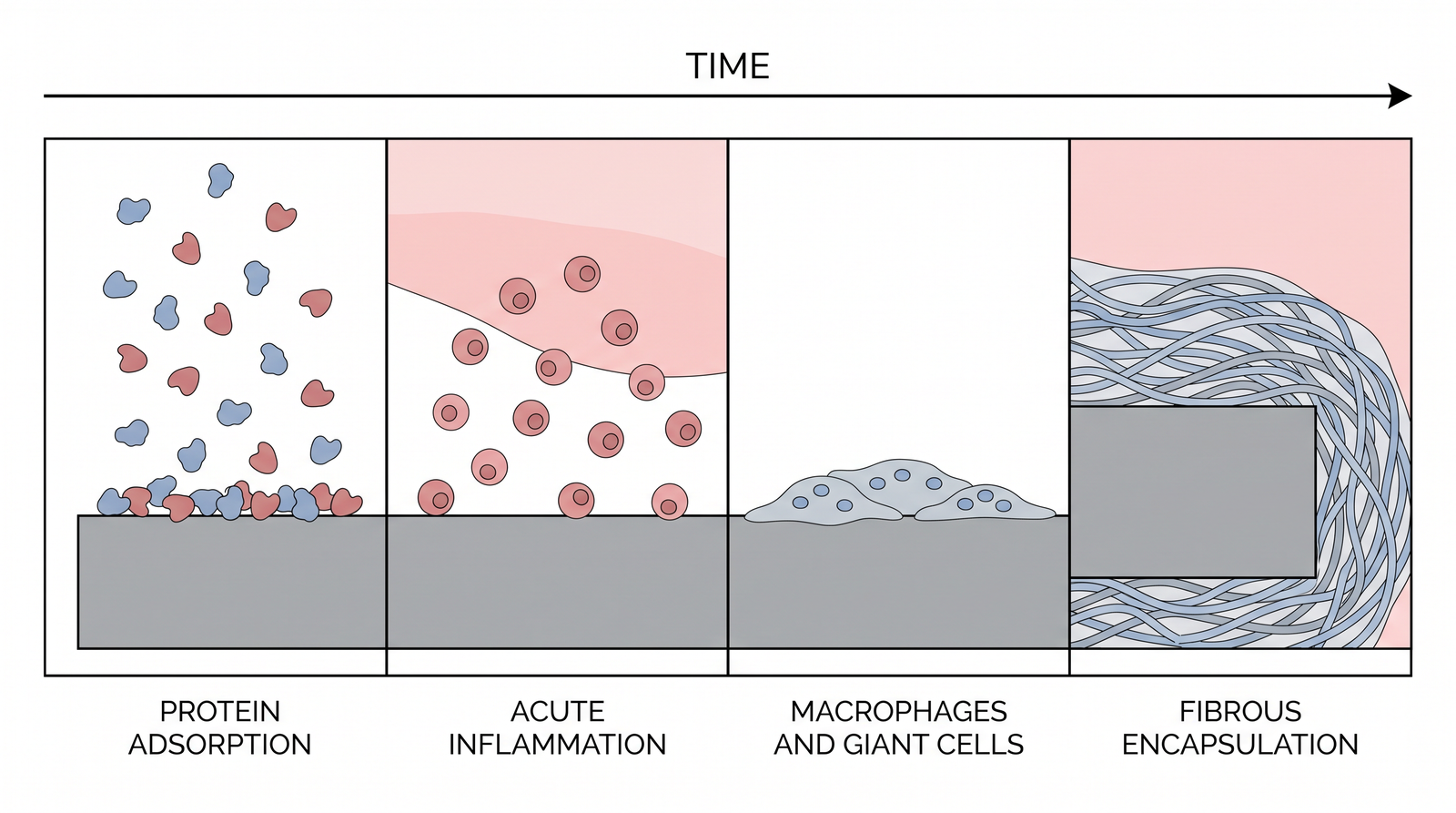
1. Protein adsorption (seconds).
Body fluid contacts the surface almost immediately, and proteins adsorb onto it. Cells rarely “see” the bare material — they interact with the adsorbed protein layer. This is why surface chemistry, charge, wettability, and topography influence the biological outcome so strongly: they determine which proteins adsorb, in what quantity, and in what conformation.
2. Acute inflammation (hours to days).
Injury from the implantation procedure plus the presence of the material recruits neutrophils and other cells of the immune system.
3. Chronic inflammation and macrophage activity (days to weeks).
Macrophages become the dominant cell type at the interface. They attempt phagocytosis; when the object is too large to engulf, they fuse into foreign body giant cells — multinucleated cells that adhere to the surface. This macrophage-driven stage is the core of the foreign body reaction, the classic host response to implanted biomaterials.[5] Recent work has begun to explain this stage in metabolic terms, describing how the metabolic state of the immune cells at the interface shapes the severity and persistence of the response — a research direction that may eventually give engineers new levers beyond surface chemistry alone.[6]
4. Fibrous encapsulation (weeks onward).
Fibroblasts deposit collagen, and the implant is typically walled off by a fibrous capsule. Capsule thickness and quality vary with material, surface, mechanical environment, and implantation site, and the pathology of this reaction differs measurably between material classes and material forms.[7]
Whether this end state is acceptable depends entirely on the device. For the titanium can of an implantable cardioverter-defibrillator, a thin stable capsule is tolerable. For a glucose biosensor that must exchange analytes with surrounding tissue, the same capsule is a failure mode. For a dental or orthopaedic implant, the goal is the opposite of encapsulation: direct bone apposition, or osseointegration — which some authors have argued is itself best understood as a controlled, balanced foreign body response rather than as the absence of one.[8]
What Determines the Response
The host response is driven by a set of interacting factors rather than by chemical composition alone.
| Factor | What it governs | Engineering example |
|---|---|---|
| Bulk chemistry | Composition, leachable species, ion release | Alloying elements released by corrosion |
| Surface chemistry and energy | Protein adsorption, cell adhesion | Plasma treatment or coating to alter wettability |
| Surface topography | Cell attachment, orientation, differentiation | Roughened vs. polished implant surfaces |
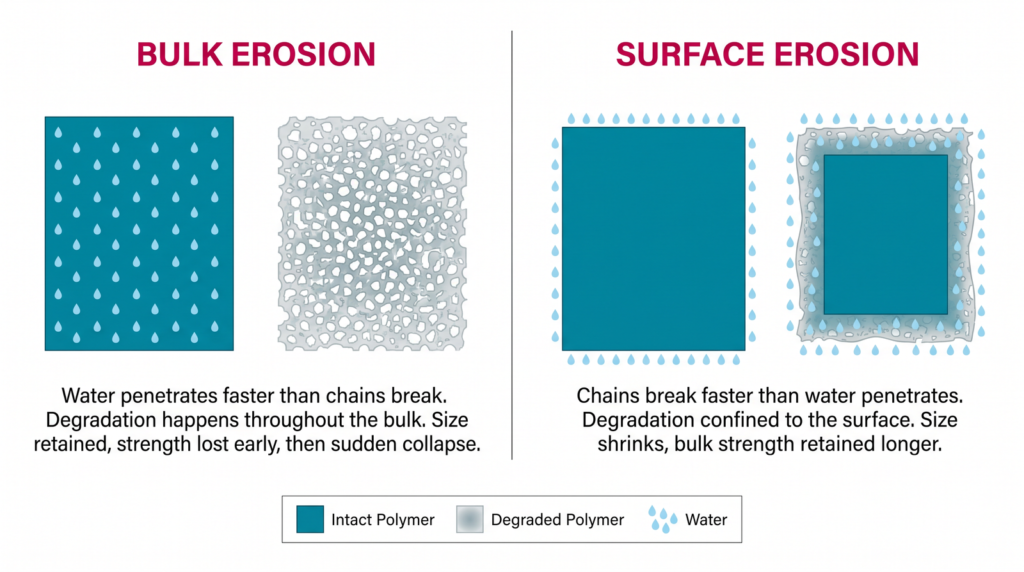
| Degradation behaviour | Rate and identity of breakdown products, local pH | Resorbable polymers releasing acidic products |
| Mechanical properties and load transfer | Micromotion, stress distribution at the interface | Stiffness mismatch between implant and bone |
| Material form and size | Cell-scale interaction | Bulk solid vs. wear particles vs. fibres |
| Manufacturing and sterilization residues | Local toxicity | Residual monomers, processing aids, sterilant residues |
| Implantation site and duration | Local tissue sensitivity and exposure | Blood contact vs. subcutaneous placement |
Two of these deserve emphasis because they are frequently underestimated.
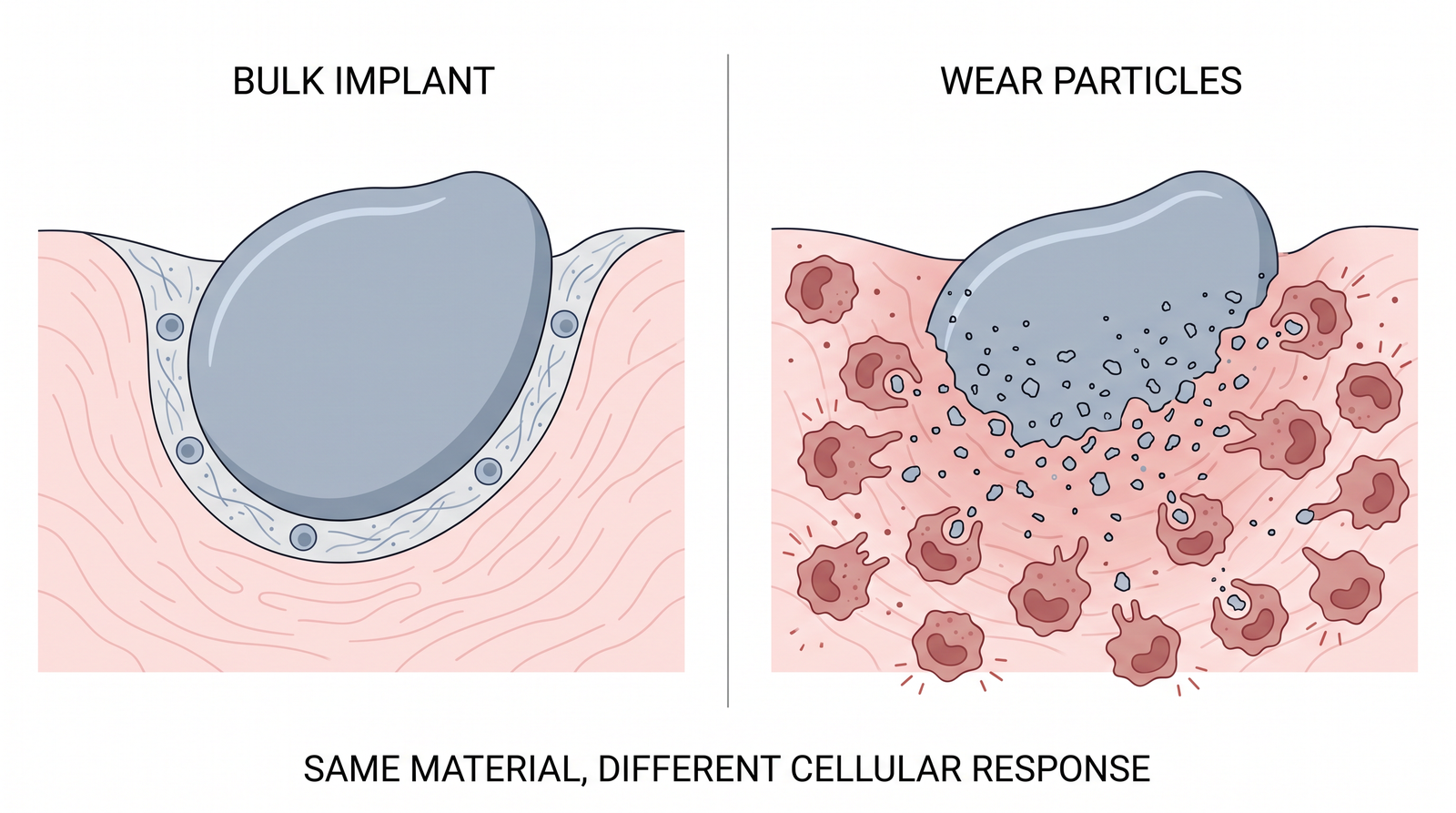
Material form matters as much as material identity. A metallic implant that is well tolerated as a bulk component can provoke a strong macrophage-mediated response once the same material is present as micron-scale particulate. The chemistry did not change; the cellular interaction did.[5][7]
Mechanics feed back into biology. Micromotion at an interface, or a large stiffness mismatch between implant and surrounding tissue, changes the mechanical signals cells receive and can shift the local response. Williams’ biocompatibility-pathways framework treats mechanotransduction as one of the drivers of the biological response, alongside sterile inflammation.[2] This is a useful reminder that biological design decisions and biomechanics are not independent.
Contact Type and Duration: The ISO 10993-1 Framework
Because biocompatibility is application-specific, the international framework classifies devices before deciding what to evaluate. Under ISO 10993-1, the cornerstone standard for the biological evaluation of medical devices, evaluation is organised by two axes:
- Nature of body contact — for example surface-contacting devices (skin, mucosa, breached surfaces), externally communicating devices (blood path, tissue, bone), and implanted devices.
- Duration of contact — conventionally grouped into limited, prolonged, and long-term contact. Consult the current edition for the exact thresholds before applying them to a project.
Combining these two axes produces the device category, which in turn indicates which biological endpoints (cytotoxicity, sensitization, irritation, systemic toxicity, genotoxicity, implantation effects, haemocompatibility, and others) warrant consideration.
Two points on standards hygiene, since engineers often work from outdated copies:
- ISO 10993-1 defines biological evaluation within a risk management process, tied to the risk management framework of ISO 14971. It is a decision framework, not a fixed test list.[9]
- The 2018 edition (Edition 5) has been withdrawn and superseded by ISO 10993-1:2025 (Edition 6).[9] In the United States, the FDA’s final guidance on the use of ISO 10993-1 was issued in September 2023.[10] Always verify the currently applicable edition and the current regulatory guidance for your market before writing a test plan — the same discipline that applies to medical device standards generally.
How Biocompatibility Is Evaluated in Practice
The modern approach is risk-based rather than test-list-based. In outline:
- Characterise the device — materials, additives, processing aids, sterilization method, contact type, contact duration, patient population.
- Characterise chemically — identify what can actually leach out under clinically relevant conditions. Chemical characterisation and toxicological risk assessment can address some endpoints without new animal testing.
- Identify relevant biological endpoints from the device category.
- Use existing data where justified — prior testing, published literature, material history in equivalent applications.
- Test only the remaining gaps, typically starting with in vitro methods (for example cytotoxicity) before considering in vivo studies.
- Document the evaluation as part of the risk file, with a rationale for every endpoint addressed and every endpoint deliberately not tested.
A common misconception is that biological evaluation means “run the ISO 10993 test battery.” It does not. The standard asks you to justify what is necessary for your specific device — which is why a strong engineering rationale can reduce testing, and a weak one increases it.
Limitations Engineers Should Understand
- Standard tests are screening tools, not clinical predictions. A cytotoxicity assay tells you a great deal about acute cell-level toxicity and very little about a fifteen-year implant interface.
- Animal models are imperfect proxies. Species differences in immune and healing responses limit direct extrapolation to humans.
- “Passed testing” is not “no host response.” Every implant provokes a response; testing establishes that the response is acceptable for the intended use.
- Long-term behaviour is hardest to evaluate. Degradation, fatigue-driven particle release, and slow corrosion act on time scales that preclinical testing rarely reproduces fully.
- The target keeps moving. For tissue engineering and regenerative devices, “inert and encapsulated” is no longer the goal — the desired outcome is a specific, constructive biological response, which tests designed around inertness were not built to demonstrate.[3][4]
- Passing biological evaluation does not guarantee acceptance. Devices can still be rejected for reasons unrelated to materials, as the practical framework for hospital acceptance decisions illustrates.
Engineering Considerations
When you are the one making the decision, work through the following:
- Define the required biological outcome first. Integration, encapsulation, resorption, or minimal interaction — each implies a different material and surface strategy.
- Specify the material as processed, not as named. Grade, supplier, additives, processing route, and sterilization method are all part of the specification that biological evaluation applies to.
- Treat any material or process change as a re-evaluation trigger, including a supplier change or a switch in sterilization method.
- Design the surface deliberately. The surface is what the biological system interacts with; bulk properties can be selected for mechanics while the surface is engineered for the biological response.
- Match mechanical behaviour to the site. Stiffness mismatch and micromotion have biological consequences, not only mechanical ones.
- Account for the degraded and worn state. Ask what the material becomes over the device lifetime, and whether that form is still acceptable.
- Plan evaluation early and build the rationale as you go. Biological evaluation is a documented argument supported by data, not a certificate issued at the end.
Key Takeaways
- Biocompatibility is the ability of a material to perform with an appropriate host response in a specific application — it is not an intrinsic property of a material.
- Every implanted material provokes a response; engineering aims for an acceptable and intended response, not for zero response.
- The host response typically progresses from protein adsorption to acute inflammation, macrophage activity and foreign body giant cell formation, and often fibrous encapsulation — whether that end state is success or failure depends on the device.
- Surface characteristics, degradation behaviour, mechanical interaction, and material form (bulk vs. particulate) can matter as much as bulk composition.
- ISO 10993-1 provides a risk-based framework organised by contact type and duration; the 2018 edition has been superseded by the 2025 edition, and applicable regulatory guidance must be checked separately.
- Standard biological testing screens for acute and mid-term risks; long-term interface behaviour remains the hardest thing to predict.
References
- Williams DF. On the mechanisms of biocompatibility. Biomaterials. 2008;29(20):2941–2953. doi:10.1016/j.biomaterials.2008.04.023
- Williams DF. Biocompatibility Pathways: Biomaterials-Induced Sterile Inflammation, Mechanotransduction, and Principles of Biocompatibility Control. ACS Biomaterials Science & Engineering. 2017;3(1):2–35. doi:10.1021/acsbiomaterials.6b00607
- Ratner BD. The biocompatibility manifesto: biocompatibility for the twenty-first century. Journal of Cardiovascular Translational Research. 2011;4(5):523–527. doi:10.1007/s12265-011-9287-x
- Williams DF. The plasticity of biocompatibility. Biomaterials. 2023;296:122077. doi:10.1016/j.biomaterials.2023.122077
- Anderson JM, Rodriguez A, Chang DT. Foreign body reaction to biomaterials. Seminars in Immunology. 2008;20(2):86–100. doi:10.1016/j.smim.2007.11.004
- Venkatesan S, Mshelia DL, Maduka CV. Immunometabolic insights into the foreign body response. Science Advances. 2025;11(51):eaed8370. doi:10.1126/sciadv.aed8370
- Klopfleisch R, Jung F. The pathology of the foreign body reaction against biomaterials. Journal of Biomedical Materials Research Part A. 2017;105(3):927–940. doi:10.1002/jbm.a.35958
- Trindade R, Albrektsson T, Tengvall P, Wennerberg A. Foreign Body Reaction to Biomaterials: On Mechanisms for Buildup and Breakdown of Osseointegration. Clinical Implant Dentistry and Related Research. 2016;18(1):192–203. doi:10.1111/cid.12274
- International Organization for Standardization. ISO 10993-1, Biological evaluation of medical devices — Part 1: Evaluation and testing within a risk management process. Edition 5 (2018) withdrawn; superseded by ISO 10993-1:2025 (Edition 6). iso.org
- U.S. Food and Drug Administration. Use of International Standard ISO 10993-1, “Biological evaluation of medical devices — Part 1: Evaluation and testing within a risk management process.” Final guidance, September 2023. fda.gov