
How Does a TENS Unit Work? Transcutaneous Electrical Nerve Stimulation Explained
A TENS unit (Transcutaneous Electrical Nerve Stimulation unit) is a small, battery-powered medical device that sends mild electrical pulses through the skin — via adhesive electrode pads — to help relieve pain, without drugs and without breaking the skin (“transcutaneous” literally means “across/through the skin”). The device works mainly through a mechanism called Gate Control Theory: the electrical pulses preferentially activate large, fast-conducting touch-sensing nerve fibers (called A-beta fibers), and that activity partially blocks or “closes a gate” on the transmission of pain signals carried by smaller, slower pain-sensing fibers (A-delta and C fibers) at the level of the spinal cord. The user (or a clinician) sets the pulse’s intensity (how strong it feels), frequency (how many pulses per second), and pulse width (how long each individual pulse lasts) to match the type of pain relief wanted — from a strong, brief tingling used for immediate pain relief, to a slower, muscle-twitching pattern used for longer-lasting effects.
Everything below unpacks that definition — starting from why nerve stimulation is used for pain, through the electrical engineering behind pulse generation and gate control, how the device is built, operated, tested, maintained, and where the field is heading next.
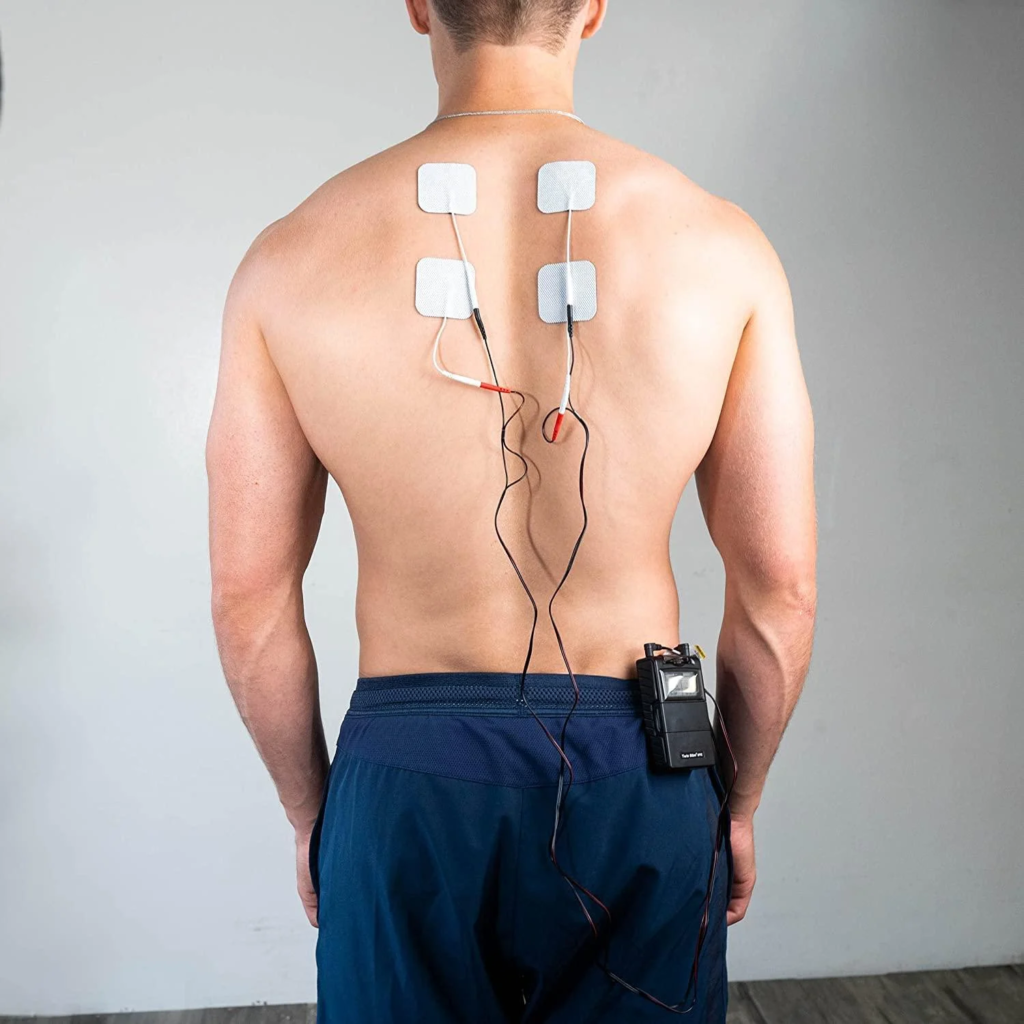
1. Why TENS is needed
Chronic and acute pain — from lower back pain, arthritis, post-surgical recovery, labor, and many musculoskeletal conditions — is often managed with medication, but many patients need or want a non-pharmacological option, either alongside medication or in place of it, particularly to avoid opioid or NSAID side effects and dependency risk. TENS gives patients and clinicians a low-risk, non-invasive, drug-free way to modulate pain signaling directly at the nervous system, one a patient can self-administer at home with an inexpensive, portable device once properly instructed.
2. Working principle: from an electrical pulse to pain relief
2.1 Gate Control Theory — the primary mechanism
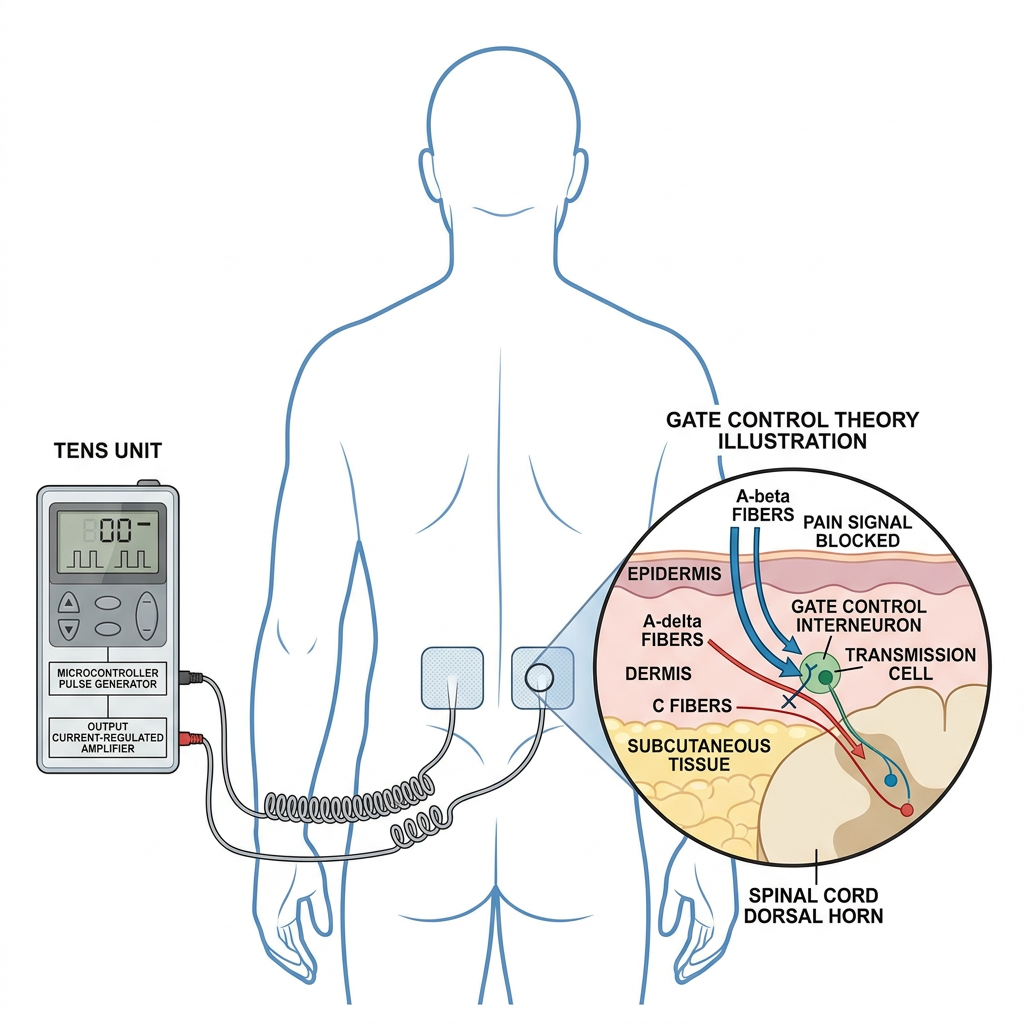
Proposed by Melzack and Wall in 1965 and still the foundational explanation for how TENS relieves pain, Gate Control Theory holds that pain signals traveling up small-diameter A-delta and C nerve fibers can be inhibited — “gated” — at the dorsal horn of the spinal cord (the first relay station where sensory nerves entering the spinal cord synapse) by simultaneous activity in large-diameter A-beta fibers, which normally carry touch and vibration sensation rather than pain. A TENS device electrically stimulates the skin strongly enough to preferentially activate those large A-beta fibers; that activity triggers pre- and post-synaptic inhibition of the pain-carrying fibers at the spinal cord level, effectively closing the “gate” through which the pain signal would otherwise pass upward to the brain.
2.2 A second mechanism: descending inhibition and neurochemical release
Beyond the spinal-cord-level gating effect, TENS use — particularly at lower stimulation frequencies — is associated with activation of descending inhibitory pathways from the brain that further suppress incoming pain signals, and with the release of the body’s own pain-modulating chemicals, including endogenous opioids, GABA, acetylcholine, serotonin (5-HT), noradrenaline, and adenosine, some of which produce longer-lasting central nervous system effects beyond the duration of stimulation itself.
2.3 The three clinical stimulation modes
| Mode | Frequency | Intensity | Sensation | Fiber activated | Onset / offset |
|---|---|---|---|---|---|
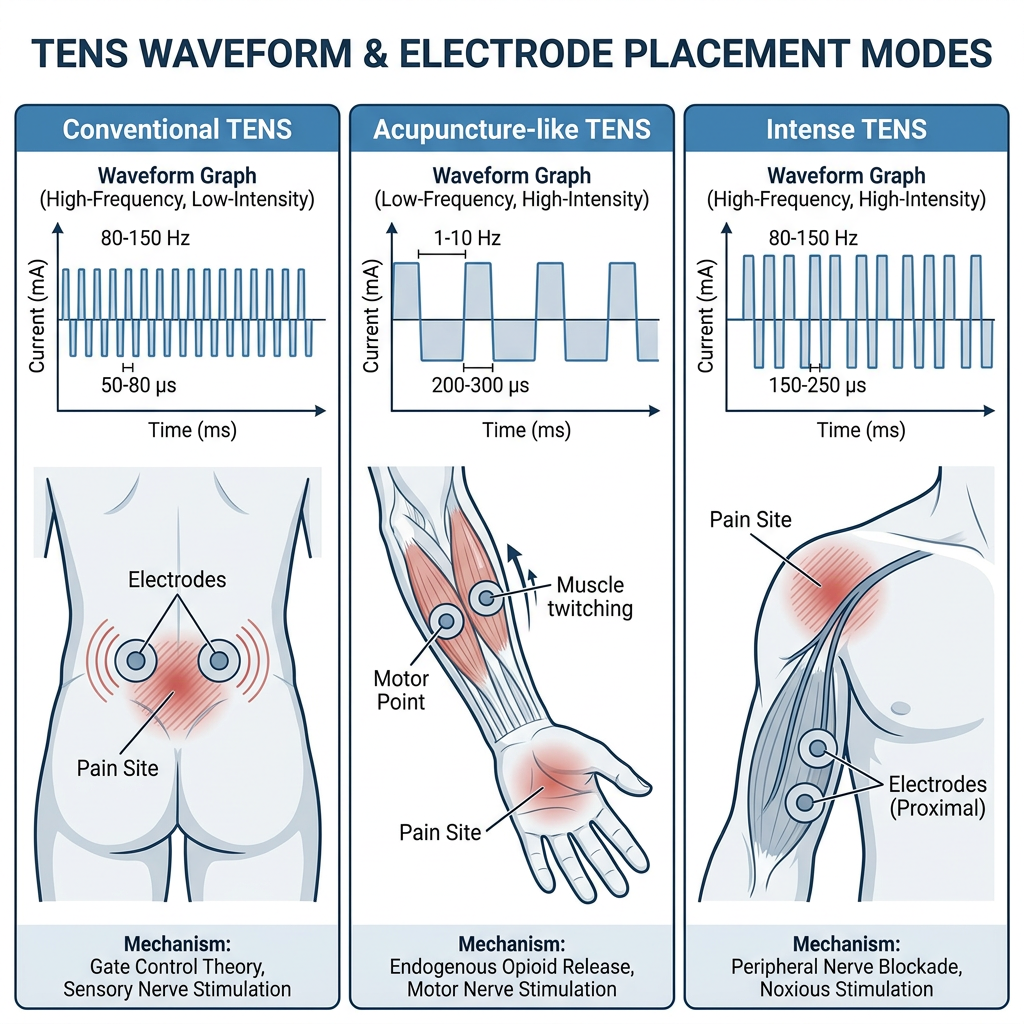
| Conventional TENS | High (10–200 pulses per second) | Low | Strong, non-painful tingling | A-beta (segmental analgesia) | Rapid onset, rapid offset |
| Acupuncture-like TENS (AL-TENS) | Low (typically <10 pps, often ~2 pps) | High | Visible muscle twitching | Small-diameter afferents (extrasegmental analgesia) | Delayed onset, delayed offset |
| Intense TENS | High (50–200 pps) | High | Uncomfortable/mildly painful | Counter-irritant effect | Rapid onset, delayed offset |
2.4 Pulse parameters that shape the stimulation
- Pulse amplitude (intensity) — how much current is delivered, typically adjustable from about 1–50 mA into a standard 1 kΩ reference load in the physiotherapy literature, though consumer devices commonly specify a wider adjustable range (up to ~80–100 mA) against their own specified load.
- Pulse duration (pulse width) — how long each individual electrical pulse lasts, typically adjustable from about 10–1000 microseconds (µs), with most therapeutic use in the 50–300 µs range; longer pulse widths have been shown computationally to drive current into deeper tissue layers, reaching nerve fibers farther from the skin surface.
- Pulse frequency (rate) — how many pulses are delivered per second, adjustable from about 1–250 pulses per second (pps) depending on the clinical mode selected
- Pulse waveform — most devices use a biphasic waveform (the current alternates direction with each pulse), either symmetrical or asymmetrical, rather than a simple monophasic (one-direction) pulse; biphasic waveforms are the standard because they don’t build up a net electrical charge in the tissue over time, reducing skin irritation risk during prolonged use.
- Pulse pattern — continuous, or delivered in “bursts” (short groups of pulses repeated at a slower rate), with some devices also offering modulation of amplitude, frequency, or pulse duration over time to reduce the nervous system’s tendency to adapt to (and stop responding to) a constant stimulus.
3. Device architecture and components
- Microcontroller and pulse generator — the core electronics that generate the precisely timed electrical pulse train according to the selected mode, frequency, pulse width, and pattern, and enforce built-in safety limits on output current.
- Output amplifier / current driver — converts the microcontroller’s low-power timing signal into the higher-voltage, current-limited pulse actually delivered to the electrodes; because skin and tissue impedance varies between patients and even changes during a session (e.g., as sweat forms under the electrode), TENS output stages are current-regulated rather than simple fixed-voltage sources, so the delivered current stays consistent despite these impedance changes.
- Electrode leads and adhesive pads — flexible wire leads connect the device to reusable adhesive gel electrode pads placed on the skin; pad size and placement directly affect current density and comfort.
- User interface — buttons or a touchscreen for selecting mode, adjusting intensity/frequency/pulse width, and setting a session timer, plus a display showing current settings and remaining time.
- Battery and power management — most modern TENS units are powered by a rechargeable lithium-ion or replaceable alkaline battery, with power management circuitry that also handles the low-battery cutoff needed to prevent an uncontrolled current delivered as voltage sags.
- Timer circuit — automatically ends a session after a preset duration (commonly adjustable from about 2 to 90 minutes on consumer devices), both for treatment-protocol adherence and as a safety limit on continuous stimulation.
4. Classification
| Category | Type | Key characteristic |
|---|---|---|
| Regulatory class (US) | Prescription (Rx) TENS device | Requires a prescription; typically used under clinical guidance for chronic pain management |
| Regulatory class (US) | Over-the-counter (OTC) TENS device | Cleared for consumer purchase without a prescription for temporary relief of minor muscle/joint pain |
| Channel count | Single-channel | One pair (or set) of electrodes, one independent stimulation circuit |
| Channel count | Dual/multi-channel | Two or more independently controllable electrode pairs, allowing simultaneous stimulation of multiple sites |
| Clinical mode | Conventional / AL-TENS / Intense TENS | See §2.3 — differ in frequency, intensity, and fiber population targeted |
5. Step-by-step: setting up and using a TENS unit
- Assess and confirm appropriateness. The clinician or user confirms TENS is appropriate for the pain being treated and checks for contraindications (§9) — for example, a cardiac pacemaker or implanted defibrillator, pregnancy (avoiding placement over the abdomen), or active skin conditions at the intended electrode site.
- Prepare the skin. The treatment area is cleaned and dried; broken or irritated skin is avoided.
- Place the electrodes. Electrode pads are positioned according to the treatment goal: directly at or around the site of pain for conventional TENS, over the relevant dermatome (skin area sharing a nerve root with the painful structure), over a motor point or acupuncture point for AL-TENS, or proximal to (upstream of) the pain site for intense TENS.
- Select the mode and starting parameters. The clinical mode (§2.3), pulse frequency, and pulse width are selected based on the treatment goal.
- Increase intensity gradually. Intensity is raised slowly from zero until the patient reports a strong, comfortable tingling sensation (conventional mode) or clear, tolerable muscle twitching (AL-TENS) — never a painful shock.
- Set the session timer and monitor. The session duration is set on the device’s timer, and skin under the electrodes is periodically checked for irritation during longer or repeated use.
- End session and check skin. After the timer ends the session, electrodes are removed and the skin is checked for redness or irritation before the pads are reused.
6. Sensing, control, and stimulation parameters
| Parameter | Typical range | Notes |
|---|---|---|
| Pulse amplitude (intensity) | ~1–50 mA (into a 1 kΩ reference load, physiotherapy literature); consumer devices commonly rated up to ~80–100 mA against their own load | Current-regulated output compensates for changing skin/tissue impedance |
| Pulse duration (pulse width) | ~10–1000 µs (commonly 50–300 µs in practice) | Longer pulse widths drive current deeper into tissue |
| Pulse frequency | ~1–250 pulses per second | Determines clinical mode and fiber population targeted (§2.3) |
| Waveform | Biphasic (symmetrical or asymmetrical), most common; monophasic less common | Biphasic avoids net charge buildup in tissue |
| Session timer | Commonly ~2–90 minutes, adjustable | Enforces protocol duration and limits continuous stimulation |
7. QA and safety-testing requirements
- Governing safety standard: IEC 60601-2-10 — the international particular standard specifying basic safety and essential performance requirements for nerve and muscle stimulators, applicable to both professional-use and home-use TENS/EMS devices. It sets limits on output current/voltage, requires protection against electrical shock, and mandates durability and reliability testing of the device.
- User-interface and misuse protection — under IEC 60601-2-10, devices must be designed to prevent operational errors and inadvertent excessive-intensity delivery, including safeguards against a sudden, unintended jump in output intensity.
- Certification and ongoing compliance — manufacturers must pass evaluation by an accredited certifying body, with certification maintained through demonstrated ongoing compliance rather than a one-time test.
- Manufacturer-level output verification — devices are tested to confirm delivered current and pulse timing stay within their specified tolerances across the rated impedance range, since patient skin/tissue impedance varies considerably between individuals and sessions.
8. Maintenance and troubleshooting
| Interval | Task | Acceptance criteria |
|---|---|---|
| Before each use | Inspect electrode pads for wear, dried-out gel, or reduced adhesion | Full, even skin contact across the pad surface; replace pads that no longer adhere well or feel dried out |
| Before each use | Inspect leads/cables for fraying or damage | No exposed wire, secure connector fit at both device and pad ends |
| Periodically | Battery check / recharge | Sufficient charge to complete a full session without a mid-session low-battery cutoff |
| Periodically | Confirm intensity output at a fixed setting feels consistent with prior sessions | No unexplained drop or spike in perceived intensity at the same numeric setting — investigate leads/pads/battery if changed |
| Failure mode | Typical signature | Usual cause |
|---|---|---|
| Weak or absent stimulation despite correct settings | Little or no perceptible sensation at normal intensity | Worn-out electrode gel, poor skin contact, low battery, or a damaged lead |
| Uneven or “hot spot” sensation under one pad | Localized stinging or excessive intensity at one area of a pad | Poor/uneven pad adhesion or a pad reused past its usable life |
| Skin irritation or redness at electrode site | Redness, itching persisting after sessions | Prolonged use at one site, sensitivity to the pad’s adhesive/gel, or excessively high intensity for the individual’s skin |
| Device won’t power on or shuts off mid-session | Blank display, unexpected shutdown | Depleted battery or a power-management fault |
9. Complications, safety, and contraindications
TENS is broadly considered low-risk when used according to labeling, but it is not appropriate for everyone and carries specific, well-documented contraindications:
- Cardiac implants — TENS is generally contraindicated over or near a cardiac pacemaker or implantable defibrillator, since electrical stimulation could potentially interfere with device sensing or function.
- Pregnancy — placement over the abdomen or lower back during pregnancy is generally avoided unless specifically directed by a clinician for labor-related use under supervision.
- Skin irritation — the most commonly reported adverse effect, from adhesive sensitivity, excessive intensity, or prolonged use at one site.
- Placement to avoid — the anterior neck (risk of affecting nerves controlling heart rate and blood pressure via the carotid sinus/vagus nerve), directly over the eyes, over broken or infected skin, and over areas of reduced or absent sensation (where the patient cannot reliably report excessive intensity).
- Electromagnetic interference — TENS devices should not be used near other electronic medical monitoring/life-support equipment where electrical interference could be a concern.
10. Regulatory and standards framework
- IEC 60601-2-10 — international particular safety standard for nerve and muscle stimulators (basic safety and essential performance), applicable to both professional and home-use TENS devices.
- IEC 60601-1 — the general basic safety and essential performance standard for medical electrical equipment, which IEC 60601-2-10 supplements with device-specific requirements.
- US regulatory pathway — TENS devices are regulated by the FDA; some TENS devices are cleared for OTC sale for temporary relief of minor muscle/joint pain, while others remain prescription (Rx)-only devices intended for chronic pain management under clinical supervision — the exact classification depends on the specific device’s indications for use and 510(k) clearance.
- EU regulatory pathway — under the EU Medical Device Regulation (Regulation (EU) 2017/745), TENS devices are generally classified as Class IIa devices.
11. Manufacturer landscape (representative, non-exhaustive)
| Manufacturer | Representative platform | Notable specifications |
|---|---|---|
| Omron | TENS 7000 (2nd Edition) | Pulse amplitude 0–80 mA adjustable (up to 100 mA max) into a 500-ohm load; pulse rate 2–150 Hz adjustable in 1 Hz steps; pulse width 50–300 µs adjustable in 10 µs increments; 5 operating modes; adjustable timer 2–90 minutes; multiple output channels; burst rate 0–5 Hz |
| Compex | Performance 2.0 (nerve/muscle stimulator) | Maximum pulse intensity 120 mA; pulse width 200–400 µs; maximum electrical charge per pulse 96 microcoulombs; standard pulse ramp-up time 3 µs; multiple therapeutic programs |
Exact parameters vary by model and firmware revision — always verify the current published datasheet for a specific model before a procurement or clinical decision.
12. Comparison: TENS vs. related electrical stimulation modalities
| Factor | TENS (pain relief) | EMS (Electrical Muscle Stimulation) | IFC (Interferential Current therapy) |
|---|---|---|---|
| Primary goal | Pain modulation via nerve fiber activation (Gate Control) | Direct muscle contraction for strengthening/rehab | Deeper tissue pain relief using crossed medium-frequency currents |
| Typical frequency | 1–250 pps | Lower frequency, higher intensity pulses tuned to produce visible contraction | Two medium-frequency currents (e.g., ~4000 Hz) that interfere to produce a lower effective “beat” frequency at depth |
| Target tissue depth | Superficial to moderate (depends on pulse width, §2.4) | Muscle fibers, moderate depth | Deeper tissue than typical TENS, due to lower skin impedance to medium-frequency current |
| Typical use case | Chronic/acute pain self-management | Muscle rehabilitation, strength/endurance training | Deeper musculoskeletal pain, larger treatment areas |
13. Future directions
Adaptive, closed-loop stimulation. Ongoing computational and clinical research into how pulse width and other parameters affect activation depth (e.g., Guillen et al., 2025) is informing more precisely tunable devices that can better match stimulation depth to the target nerve fiber population for a given patient and condition.
Wearable, connected TENS. Smaller, app-connected TENS devices are extending use from short in-clinic or at-home sessions toward more continuous, discreetly wearable pain management, with programmable, physician-set protocols the patient can’t easily override.
Personalized parameter selection. As the mechanistic understanding of gate control, descending inhibition, and neurochemical effects matures, expect continued movement toward parameter presets tailored to specific pain conditions rather than one-size-fits-all default settings.
14. Conclusion
A TENS unit’s engineering task is to turn a battery and a microcontroller into a precisely controllable electrical pulse train — adjustable in amplitude, frequency, and pulse width — that can be delivered safely and comfortably through the skin. The clinical payoff of that engineering is Gate Control Theory in action: strong enough, well-placed stimulation of touch-sensing nerve fibers can measurably dampen the transmission of pain signals at the spinal cord, with a further, longer-lasting assist from the body’s own descending inhibitory and neurochemical pain-modulating systems. The safety envelope defined by IEC 60601-2-10 — current limits, misuse protection, durability testing — is what makes it possible for patients to safely run that stimulation themselves, at home, without clinical supervision for every session.
FAQ
Does a TENS unit actually relieve pain, or is it just a distraction?
The leading explanation, Gate Control Theory, describes a specific physiological mechanism: TENS activates large touch-sensing nerve fibers strongly enough that their activity inhibits pain-signal transmission at the spinal cord, and lower-frequency use is also linked to the release of the body’s own pain-modulating chemicals. It’s a real neurophysiological effect, not merely a placebo or distraction, though individual response varies and it works best as one part of a broader pain-management approach.
How do I know what intensity, frequency, and pulse width to use?
It depends on the treatment goal: a strong, high-frequency, low-intensity “conventional” setting gives fast, short-lived relief; a lower-frequency, higher-intensity “acupuncture-like” setting (producing visible muscle twitching) gives slower-onset but longer-lasting relief. A clinician’s guidance — or the device’s built-in mode presets — should generally set the starting point; intensity itself should always be raised gradually to a strong but comfortable level, never to the point of pain.
Is a TENS unit safe to use at home without supervision?
For most people with typical musculoskeletal pain and no contraindications, yes — many devices are cleared for over-the-counter home use. It is not appropriate for people with a cardiac pacemaker or implanted defibrillator, over broken or infected skin, over the front of the neck, or during pregnancy without a clinician’s specific guidance, and any device sold or prescribed carries labeled placement and use restrictions that should be followed.
Why do TENS devices use a biphasic (alternating-direction) pulse instead of a simple one-direction pulse?
A pulse that always flows in the same direction gradually builds up a net electrical charge in the skin and underlying tissue, which increases the risk of skin irritation over a session or repeated use. A biphasic waveform — alternating direction with each pulse — keeps the net charge close to zero over time, which is why it’s the standard design in modern TENS devices.
References
[1]: Johnson, M. (2009). Transcutaneous Electrical Nerve Stimulation (TENS): A Possible Aid for Pain Relief in Developing Countries? The Libyan Journal of Medicine, 4. https://doi.org/10.4176/090119
[2]: Guillen, A., Truong, D.Q., Cakmak, Y.O., Li, S., Datta, A. (2025). The interplay between pulse width and activation depth in TENS: a computational study. Frontiers in Pain Research. https://doi.org/10.3389/fpain.2025.1526277
[3]: IEC 60601-2-10 — Medical electrical equipment: Particular requirements for the basic safety and essential performance of nerve and muscle stimulators. International Electrotechnical Commission.
[4]: Omron. TENS 7000 (2nd Edition) Digital TENS Unit — Product Specifications.
[5]: Compex. Performance 2.0 Nerve and Muscle Stimulator — User Manual.