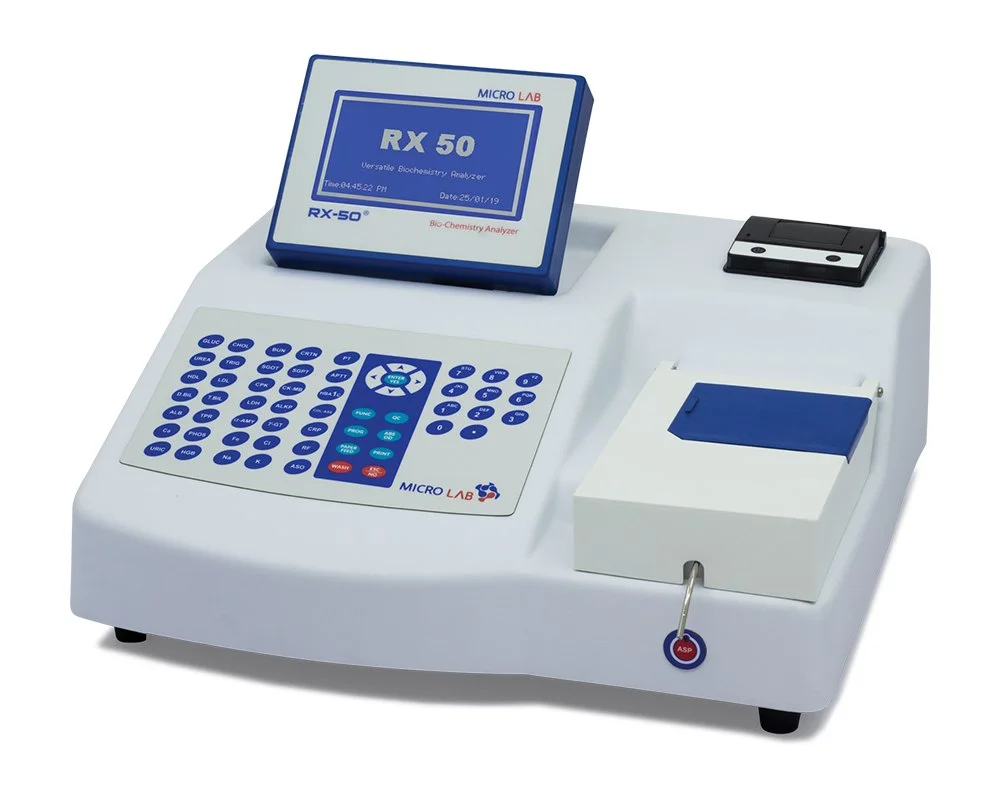
How Does a Blood Gas Analyzer Work? Electrochemical Sensing Explained — Biomedical Engineering Guide
A blood gas analyzer is a diagnostic instrument that measures a patient’s acid–base status and oxygenation directly from a small whole-blood sample — typically pH, partial pressure of carbon dioxide (pCO2), and partial pressure of oxygen (pO2) — usually alongside electrolytes (sodium, potassium, chloride, ionized calcium), metabolites (glucose, lactate), and, on many modern devices, co-oximetry (total hemoglobin and its fractions: oxyhemoglobin, deoxyhemoglobin, carboxyhemoglobin, methemoglobin). The three core parameters are measured by two different electrochemical principles: pH and pCO2 by potentiometry using glass and modified glass (Severinghaus-type) electrodes, and pO2 by amperometry. Everything else the report shows — bicarbonate, total CO2, base excess, oxygen saturation on analyzers without a co-oximeter — is calculated from those directly measured values rather than measured independently. Because blood gas results change rapidly after a sample is drawn, analysis speed and correct sample handling matter as much as the sensor technology itself; the field treats blood gas analysis (BGA) as a first-priority test meant to be reported within 30 minutes of collection.
Everything below unpacks that definition — from the electrochemistry of each sensor, through calibration and quality control, to point-of-care deployment and where the technology is heading.
Table of Contents
- 1. Why blood gas analysis is a distinct measurement problem
- 2. Working principle: how each parameter is actually measured
- 3. Device architecture: bench-top vs. point-of-care cartridge systems
- 4. Accuracy and performance: what the published comparisons show
- 5. QA and testing: what a working device must demonstrate
- 6. Complications, safety, and failure modes
- 7. Maintenance and troubleshooting
- 8. Regulatory and standards framework
- 9. Manufacturer landscape
- 10. Bench-top vs. point-of-care: choosing the right deployment
- 11. Future directions
- Conclusion
- FAQ
- References
A practical, numbers-first guide for biomedical engineers — sensing principle, calibration and QC, clinical use, and where the technology is heading, built on verified peer-reviewed and regulatory literature.
1. Why blood gas analysis is a distinct measurement problem
Acid–base and oxygenation status change on the order of minutes in a critically ill patient, and the sample itself keeps changing after it leaves the body: red and white blood cells continue their metabolism in the syringe, consuming oxygen and glucose and producing lactate and CO2. Published guidance quantifies this drift — blood pH falls at roughly 0.02–0.03 pH units per hour at room temperature (about 22°C), and less than 0.01 pH units per hour if the sample is kept at 4°C — with corresponding shifts in glucose, lactate, and pCO2 driven by ongoing glycolysis and cellular respiration.1 That combination — a result needed urgently and a sample that degrades continuously — is why blood gas analyzers are built and operated differently from routine clinical chemistry instruments: fast electrochemical sensing, immediate analysis (ideally within 30 minutes of draw), and strict handling protocols for elevated white-cell-count samples, which must be analyzed immediately because of markedly increased glycolytic activity.1
2. Working principle: how each parameter is actually measured
- Sample introduction — a whole-blood sample, drawn anaerobically into a heparinized syringe or capillary tube to prevent both clotting and gas exchange with room air, is introduced into the analyzer, typically by aspiration through a sipper probe. Any air bubble that forms in the remaining sample should be expelled immediately if a repeat measurement will be needed, since it can alter dissolved-gas readings.1
- pH measurement (potentiometry) — a glass pH electrode develops a voltage proportional to the hydrogen ion activity difference between the blood sample and an internal reference solution, following the Nernst relationship; this voltage is compared against a reference electrode to compute pH.
- pCO2 measurement (potentiometry, Severinghaus principle) — the Severinghaus electrode is a modified glass pH electrode: CO2 from the sample diffuses across a gas-permeable membrane into a thin film of bicarbonate solution surrounding the pH-sensing glass tip, where it reacts to shift the local pH. Because the CO2-to-pH relationship in that bicarbonate film follows a known equilibrium, the pH electrode’s output is translated into a pCO2 value rather than measuring CO2 gas directly.2
- pO2 measurement (amperometry) — oxygen diffuses across a membrane to a polarized electrode (classically a Clark-type electrode), where it is electrochemically reduced at a cathode; the resulting current is proportional to the partial pressure of dissolved oxygen reaching the electrode, giving a direct amperometric pO2 reading.
- Co-oximetry (optical, on equipped analyzers) — total hemoglobin and its fractions (oxyhemoglobin, deoxyhemoglobin, carboxyhemoglobin, methemoglobin) are measured optically by spectrophotometry at multiple wavelengths, since each hemoglobin species has a distinct absorption spectrum; oxygen saturation (sO2) is then reported directly from this measurement. Analyzers without an integrated co-oximeter instead estimate sO2 from the measured pO2 and other parameters rather than measuring it directly — a distinction that affects accuracy in patients with abnormal hemoglobin fractions (e.g., carbon monoxide poisoning).1
- Electrolytes and metabolites — ion-selective electrodes (ISEs) measure sodium, potassium, chloride, ionized calcium, and ionized magnesium by potentiometry, using membranes selective for each ion; glucose and lactate are typically measured amperometrically via enzyme-based (oxidase) electrodes. Modern multi-parameter cartridges bundle these alongside the core blood-gas sensors on a single-use sensor card.3
- Calculated parameters — total CO2, bicarbonate concentration, base excess, and (on analyzers lacking co-oximetry) oxygen saturation are computed from the directly measured values using established physiological equations, not measured as independent physical quantities.1
3. Device architecture: bench-top vs. point-of-care cartridge systems
Blood gas analyzers exist on a spectrum from large, multi-use bench-top laboratory instruments to small, single-use cartridge-based point-of-care (POC) devices:
- Bench-top analyzers (e.g., laboratory-sited systems) use reusable electrode modules, integrated automated quality-control (AutoQC) fluid packs, and higher sample throughput — one published bench-top system’s ordering specification lists 30 samples per hour, 17 measured plus 40 calculated parameters, and a sample volume range of roughly 25–123 µL depending on configuration.3
- Point-of-care cartridge systems (e.g., handheld or portable devices) integrate all sensors — blood gas, electrolyte, metabolite, and sometimes co-oximetry — onto a single disposable cartridge or cassette that is factory-calibrated and discarded after one or a limited number of uses, trading some of the bench-top’s throughput and automated QC infrastructure for speed and deployment flexibility at the bedside, in the emergency department, or in the field.4
- Housing and connectivity — both device classes typically include onboard software that automatically monitors sensor and cartridge/electrode health (one commercial POC system’s onboard quality system monitors on the order of 150 sensor characteristics that could affect result accuracy) and connect to hospital information/POC data-management systems for result transmission and traceability.
4. Accuracy and performance: what the published comparisons show
- Method-comparison studies against reference/laboratory methods are the standard way manufacturers and independent labs establish analytical performance; a 2023 comparative evaluation of a point-of-care system against established methods reported the device had “adequate imprecision and comparable accuracy” for its measured analytes, while flagging temperature and sample-handling sensitivities as ongoing considerations for POC blood testing generally.5
- A 2023 comparison of an integrated blood-gas-analyzer creatinine/BUN module against four widely used clinical chemistry analyzers found mean differences within clinically acceptable limits, illustrating how blood gas analyzers increasingly extend beyond the classic pH/pCO2/pO2 trio into renal-function metabolites relevant to ICU care.6
- An analytical performance evaluation of four cartridge-type blood gas analyzers (a widely cited independent comparison) established the now-standard practice of benchmarking cartridge-based POC devices against each other and against bench-top reference systems across the full panel of blood gas, electrolyte, and metabolite analytes, not just the three classical gases.7
- Accuracy depends on more than the sensor — pre-analytical handling (anaerobic draw, prompt analysis, correct anticoagulant, temperature control) contributes materially to result validity, which is why CLSI guidance documents devote as much attention to specimen collection and handling as to the analyzer itself.1
5. QA and testing: what a working device must demonstrate
- Internal and automated quality control — analyzers run periodic QC material at defined intervals (often multiple levels spanning the clinical range) to verify sensor calibration remains within acceptable limits; many POC and bench-top systems automate this via integrated AutoQC modules or cartridge-embedded QC checks.
- CLSI C46-A2, “Blood gas and pH analysis and related measurements; approved guideline,” consolidates prior CLSI documents into unified guidance covering blood gas, pH, hemoglobin fractions, oxygen content, electrolyte, and metabolite measurement — the primary US laboratory-medicine reference standard for this device category.8
- CLSI GP43-A4 (formerly H11-A4), “Procedures for the collection of arterial blood specimens,” governs the pre-analytical sampling step that determines whether the analyzer ever receives a valid specimen in the first place.1
- Two-point (or multi-point) gas calibration — pO2 and pCO2 sensors are periodically calibrated against gas mixtures of known, traceable composition; pH sensors are calibrated against buffer solutions of known pH — both essential because electrochemical sensor drift over time and use is expected, not exceptional.
- Correlation and bias studies — regulatory clearance and ongoing quality programs rely on statistical method-comparison techniques (e.g., Bland–Altman bias/limits-of-agreement analysis) to demonstrate that a device’s results agree acceptably with an established reference method across the clinically relevant range.
6. Complications, safety, and failure modes
- Sample degradation before analysis — delayed analysis after a room-temperature draw systematically shifts pH downward and pCO2/lactate upward through ongoing cellular metabolism; the CLSI-cited decay rates (≈0.02–0.03 pH units/hour at 22°C) mean a delayed sample can return a result that no longer reflects the patient’s actual status at draw time.1
- Air bubble contamination — an air bubble introduced during or after sampling equilibrates gas exchange with the sample, altering pO2 and pCO2 readings; standard practice is to expel any bubble immediately and, when in doubt, re-draw rather than trust a bubble-contaminated result.1
- Elevated white-cell-count samples — markedly increased glycolysis in leukocyte-rich samples accelerates pH, glucose, lactate, and pCO2 drift, requiring immediate analysis rather than the standard handling window.1
- Missing co-oximetry misleads oxygen-saturation reporting — on analyzers without integrated co-oximetry, sO2 is estimated from pO2 rather than measured directly; in patients with abnormal hemoglobin fractions (carbon monoxide poisoning, methemoglobinemia), this estimation can meaningfully diverge from true oxygen-carrying status, a clinically important limitation to recognize rather than a device malfunction.1
- Sensor/cartridge drift and expiry — electrochemical sensors and factory-calibrated cartridges have finite service lives; using expired cartridges or failing to perform scheduled calibration/QC risks silent accuracy drift that only periodic QC material testing reliably catches.
- Discordant results between analyzer types — because different manufacturers’ devices can use different sensor technologies, membrane materials, or calibration references, results for the same sample can show measurable device-to-device bias, which is precisely why independent comparative evaluations against reference methods remain an active area of clinical laboratory research.7
7. Maintenance and troubleshooting
| Symptom | Likely cause | Action |
|---|---|---|
| Result flagged as out of QC range | Sensor drift, expired calibration gas/buffer, degraded cartridge | Re-run QC material; recalibrate against traceable gas/buffer standards; replace sensor cartridge if drift persists |
| pH/pCO2 result inconsistent with clinical picture | Delayed sample analysis, room-temperature storage beyond the handling window | Confirm time from draw to analysis; re-draw and analyze immediately if delay exceeded protocol |
| Unexpectedly low pO2/pCO2 discordant with prior results | Air bubble introduced during sampling or storage | Expel visible air bubbles immediately; re-draw anaerobically if a repeat is needed |
| sO2 result seems inconsistent with clinical suspicion of CO poisoning or methemoglobinemia | Analyzer lacks integrated co-oximetry and is estimating sO2 from pO2 alone | Confirm whether the device model includes co-oximetry; if not, order a co-oximetry-capable test when abnormal hemoglobin fractions are suspected |
| Frequent unexplained result drift in high-WBC patients | Elevated white-cell-count sample metabolizing rapidly | Analyze immediately per protocol for leukocytosis samples; do not allow standard handling delay |
| Persistent discordance between two analyzer models on split samples | Differing sensor technology/calibration reference between devices | Run a formal method-comparison/bias study; do not assume either device is simply “wrong” without statistical comparison |
8. Regulatory and standards framework
- FDA classification (US) — a blood gases (pCO2, pO2) and blood pH test system is defined and classified under 21 CFR § 862.1120 as a device intended to measure blood gases and/or pH of blood, serum, or plasma; this classification governs premarket requirements for the device category.9
- CLSI C46-A2 — the consolidated US laboratory-medicine guideline for blood gas and pH analysis and related measurements, unifying six prior CLSI documents into a single reference covering blood gas, pH, hemoglobin fractions, oxygen content, electrolyte, and metabolite testing.8
- CLSI GP43-A4 — governs arterial blood specimen collection procedure, the pre-analytical step immediately preceding analysis.1
- National professional-society recommendations (such as those issued by the Croatian Society of Medical Biochemistry and Laboratory Medicine, built directly on the CLSI framework) illustrate how blood-gas-specific standardization efforts translate CLSI guidance into local laboratory practice.1
9. Manufacturer landscape
| Manufacturer | Representative system | Technology / notes |
|---|---|---|
| Roche Diagnostics | cobas b 123 POC system | Bench-top-class POC/laboratory system measuring pH, blood gases, electrolytes, hematocrit, metabolites (glucose, lactate), total hemoglobin and hemoglobin derivatives, oxygen saturation, and neonatal bilirubin; published specification lists 30 samples/hour throughput and 25–123 µL sample volume depending on configuration |
| Abbott | i-STAT Alinity | Handheld, portable point-of-care blood testing device; a 2023 published evaluation reported adequate imprecision and accuracy comparable to established methods, with an onboard quality system monitoring roughly 150 sensor characteristics |
| Siemens Healthineers | epoc Blood Analysis System | Handheld, wireless point-of-care system reporting lab-accurate results in under a minute; supports blood gas, electrolyte, metabolite, and calculated-parameter reporting from a single-use test card |
| Radiometer | ABL90 FLEX PLUS | Benchtop point-of-care blood gas analyzer reporting results in roughly 35 seconds across up to 19 parameters (including creatinine and urea in extended configurations) from a small sample volume (~65 µL) |
10. Bench-top vs. point-of-care: choosing the right deployment
| Factor | Bench-top laboratory analyzer | Point-of-care cartridge analyzer |
|---|---|---|
| Typical location | Central or satellite clinical laboratory | ICU bedside, emergency department, operating room, field/ambulance |
| Sample throughput | Higher (e.g., ~30 samples/hour on a published bench-top spec) | Lower per-device, but distributed across many bedside units |
| Result turnaround | Fast, but includes specimen transport time to the lab | Fastest — no transport delay, result at or near the point of collection |
| Calibration model | Reusable electrode modules with scheduled/automated multi-level QC | Factory-calibrated, single-use or limited-use cartridges with onboard QC monitoring |
| Best-suited use case | High-volume centralized testing where transport time is acceptable | Time-critical decisions (resuscitation, ventilator titration, anesthesia) where transport delay would be clinically costly |
11. Future directions
Independent analytical-performance research on point-of-care and cartridge-based blood gas systems remains an active field, driven by the continued clinical shift toward decentralized, bedside testing in critical care, emergency medicine, and prehospital settings.56 Ongoing work on temperature-related measurement challenges for handheld POC devices — relevant to prehospital and field deployment where ambient temperature control cannot be guaranteed — reflects an engineering effort to extend blood gas analysis reliability beyond the controlled environment of a hospital laboratory or ICU.4 As multi-analyte cartridges continue absorbing renal-function and other metabolic markers alongside the classical blood-gas panel, comparative validation against established reference methods will likely remain the primary gatekeeper for clinical adoption of each new configuration.67
Conclusion
A blood gas analyzer’s core engineering task — turning a few microliters of whole blood into a fast, accurate acid–base and oxygenation profile — rests on two workhorse electrochemical principles: potentiometry for pH and pCO2 (via glass and Severinghaus-type electrodes) and amperometry for pO2 (via Clark-type electrodes), extended with ion-selective electrodes, enzymatic metabolite sensors, and optional optical co-oximetry. The engineering and clinical subtlety this guide covered — sample-degradation kinetics, the pO2-estimated-vs-measured sO2 distinction, and cartridge/sensor drift — is exactly what the CLSI and FDA standards framework (CLSI C46-A2, CLSI GP43-A4, 21 CFR § 862.1120) exists to keep in check before a result reaches a bedside decision.
FAQ
What does a blood gas analyzer actually measure directly, versus calculate? It directly measures pH, pCO2, and pO2 (plus electrolytes, metabolites, and co-oximetry hemoglobin fractions on equipped devices); bicarbonate, total CO2, base excess, and (on non-co-oximeter devices) oxygen saturation are calculated from those direct measurements rather than measured independently.1
Why does a blood sample need to be analyzed so quickly after collection? Red and white blood cells keep metabolizing in the syringe, shifting pH downward and pCO2, lactate, and glucose values away from the true in-vivo status at roughly 0.02–0.03 pH units per hour at room temperature — which is why blood gas testing is treated as a first-priority test with a roughly 30-minute reporting target.1
Is a point-of-care blood gas analyzer as accurate as a laboratory bench-top system? Published comparative-performance studies generally report comparable accuracy and acceptable imprecision for modern point-of-care systems against reference methods, though temperature sensitivity and sample-handling conditions remain active areas of evaluation, particularly for field and prehospital deployment.54
Why might reported oxygen saturation be misleading in a patient with carbon monoxide poisoning? If the analyzer lacks integrated co-oximetry, it estimates oxygen saturation from the measured pO2 rather than directly measuring the actual hemoglobin fractions present, so it cannot detect that carboxyhemoglobin — not oxyhemoglobin — is occupying binding sites; a co-oximetry-capable device measures hemoglobin fractions directly and will not have this blind spot.1
References
-
Dukić L, Kopčinović LM, Dorotić A, Baršić I. “Blood gas testing and related measurements: National recommendations on behalf of the Croatian Society of Medical Biochemistry and Laboratory Medicine.” Biochemia Medica. 2016;26(3):318-336. doi: 10.11613/BM.2016.036 ↩↩↩↩↩↩↩↩↩↩↩↩↩↩↩↩
-
Severinghaus JW, Bradley AF. “Electrodes for blood pO2 and pCO2 determination.” Journal of Applied Physiology. 1958;13(3):515-520. doi: 10.1152/jappl.1958.13.3.515 ↩
-
Roche Diagnostics. cobas® b 123 POC system — published product specification. ↩↩
-
Füzéry AK, Elian FA, Kost GJ. “A Review of Temperature-Related Challenges and Solutions for the Abbott i-STAT and Siemens Healthineers Epoc Devices.” Clinical Biochemistry. 2022. doi: 10.1016/j.clinbiochem.2022.08.013 ↩↩↩
-
Larcher R, et al. “Analytical Performances of the Novel i-STAT Alinity Point-of-Care Analyzer.” Diagnostics. 2023;13(2):297. doi: 10.3390/diagnostics13020297 ↩↩↩
-
Lim HJ, et al. “Evaluation of the Accuracy of Cr and BUN Using the ABL90 FLEX PLUS Blood Gas Analyzer.” Journal of Clinical Medicine. 2023;12(5):1940. doi: 10.3390/jcm12051940 ↩↩↩
-
De Koninck AS, De Decker K, Van Bocxlaer J, Meeus P, Van Hoovels L. “Analytical Performance Evaluation of Four Cartridge-Type Blood Gas Analyzers.” Clinical Chemistry and Laboratory Medicine. 2012;50(6):1083-1091. doi: 10.1515/cclm-2011-0685 ↩↩↩
-
CLSI. “Blood Gas and pH Analysis and Related Measurements; Approved Guideline — Second Edition (C46-A2).” Clinical and Laboratory Standards Institute. ↩↩
-
U.S. FDA. 21 CFR § 862.1120, “Blood gases (PCO2, PO2) and blood pH test system.” ↩