How Does a Biochemistry Analyzer Work? Optical System, Automation, QC, and Biomedical Engineering Guide
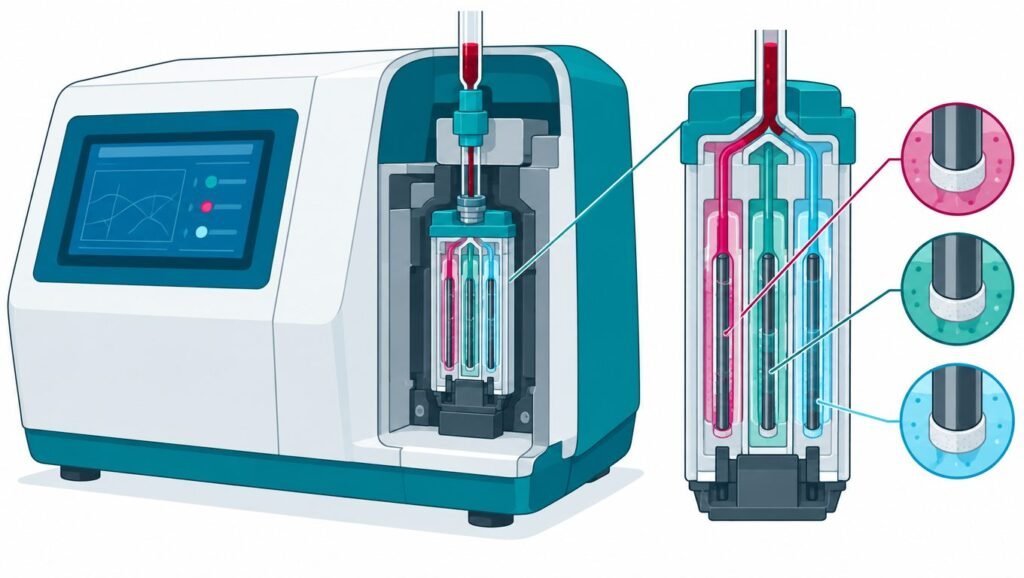
A biochemistry analyzer (also called a clinical chemistry analyzer) is an automated laboratory instrument that measures the concentration of chemical substances in blood, serum, plasma, or urine — glucose, electrolytes, liver enzymes, kidney markers, lipids — by mixing a small sample with a specific reagent and then measuring the resulting reaction with light or an electrode. Most measurements use one of two physical principles: photometric/colorimetric detection, where a reagent turns the sample a particular color or turbidity in proportion to how much of the target substance is present, and light passed through the mixture is measured to calculate that concentration (Beer-Lambert law); or ion-selective electrode (ISE) detection, where a membrane generates a tiny voltage proportional to the concentration of a specific ion, such as sodium or potassium. A modern hospital analyzer runs these reactions automatically, sample after sample, at rates from roughly 120 up to 700+ tests per hour, while continuously checking its own accuracy against reference materials.
Everything below unpacks that definition — from the optical/electrochemical physics, through the automation architecture and calibration/QC rules that keep results trustworthy, to failure modes, testing standards, and where the technology is heading next.

Table of contents
- 1. Why automated chemistry analysis matters
- 2. Working principles: how the analyzer actually measures a substance
- 3. Optical system architecture
- 4. Reagent and sample handling
- 5. Automation architecture
- 6. Calibration and QC procedures
- 7. Accuracy and precision: real comparative data
- 8. Common failure modes and QC flags
- 9. Throughput specifications by platform tier
- 10. Regulatory and standards framework
- 11. Manufacturer landscape (representative, non-exhaustive)
- 12. Future directions
- 13. Conclusion
- FAQ
- References
A practical, numbers-first guide for biomedical engineers — photometric and ion-selective measurement principles, optical system design, automation architecture, calibration/QC rules, throughput specs, failure modes, and regulatory standards, built on verified 2018–2026 literature.
1. Why automated chemistry analysis matters
Manual chemistry testing — pipetting reagent into a tube, timing a reaction, reading a color by eye or with a simple photometer — does not scale to a hospital lab running thousands of tests a day, and it introduces exactly the kind of small timing and volume errors that shift a borderline glucose or potassium result across a clinical decision threshold. A biochemistry analyzer solves this by mechanizing every step — sample aspiration, reagent dispensing, mixing, timed incubation at a controlled temperature, and optical or electrochemical measurement — so that the same test run on the same sample gives the same result every time, at a throughput measured in hundreds of tests per hour rather than dozens per day.
2. Working principles: how the analyzer actually measures a substance
2.1 Photometric/colorimetric measurement
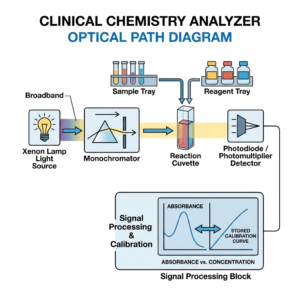
Most chemistry tests — glucose, liver function tests (ALT, AST, bilirubin), renal function tests (urea, creatinine), lipids, and cardiac enzymes — work by mixing the sample with a reagent engineered to produce a color change or absorbance shift specifically proportional to the target substance’s concentration. The analyzer shines light of a specific wavelength through the reaction mixture and measures how much light comes out the other side; per the Beer-Lambert law, the amount of light absorbed is directly proportional to concentration, so measuring absorbance and comparing it against a calibration curve yields the concentration.1
2.2 Ion-selective electrode (ISE) measurement
Electrolytes (sodium, potassium, chloride) are more often measured with an ISE — a membrane-based electrode that binds selectively to one type of ion and generates a small voltage proportional to that ion’s activity in solution, following the Nernst equation. ISE methods are faster, safer for the operator, and unaffected by sample color or turbidity — a real advantage over photometry for a hemolyzed or lipemic sample. A comparative study of an ISE-based analyzer (Beckman Coulter Synchron CX9 PRO) against traditional flame photometry found acceptable agreement for sodium (mean difference −7.89 mEq/L, SD 17.28) and potassium (mean difference −0.25 mEq/L, SD 0.75).2
2.3 Turbidimetric measurement
For analytes like triglycerides and immunoglobulins, some assays measure the turbidity (cloudiness) a reaction produces rather than a color change — a related but distinct optical technique that complements standard colorimetry on the same platform.2
3. Optical system architecture
A photometric measurement channel has four core components, all of which sit directly on the instrument’s throughput, accuracy, and failure-mode profile:
| Component | Function | Typical specification |
|---|---|---|
| Light source | Generates the photons used for measurement | Xenon lamp (covering roughly 300–900 nm) or LED arrays; xenon lamp service life around 10,000 hours |
| Monochromator | Selects the specific wavelength each assay needs | Optical filters or diffraction gratings, typically ±2–5 nm bandwidth |
| Cuvette | Holds the sample-reagent reaction mixture in the light path | Disposable or reusable, typically 10–50 µL reaction volume |
| Photodetector | Measures the light that passes through the cuvette | Photodiode or photomultiplier tube (PMT) |
The instrument compares the light transmitted through the reaction cuvette against a reference blank and a stored calibration curve to convert the measured absorbance into a reported concentration.1
4. Reagent and sample handling
- Sample volume: typically 5–10 µL per test — a deliberately small draw that lets one venous blood tube support dozens of different assays.
- Sample capacity: 40–80 sample positions on standard platforms, expandable to 200+ on high-throughput analyzers.
- Sample stability: samples are held at 4–10 °C on the loading deck, then warmed to 37 °C during the actual reaction, since most enzymatic assays are calibrated to run at body temperature.
- Reagent positions: 40–200 onboard reagent slots depending on analyzer tier, each temperature-controlled and tracked by barcode for expiration and lot number.910
- Serum quality indices (HIL): every sample is automatically screened for hemolysis, lipemia, and icterus (the “H/L/I index”) before the requested tests are even run, since each of these three conditions can distort specific assay types (see Section 8).
5. Automation architecture
- Discrete/random-access analyzers (the modern standard): each sample gets its own independent reaction, and the system can run any combination of tests on any sample in any order — the architecture that lets a single instrument serve a whole hospital’s varied daily test mix efficiently.1
- Batch analyzers: process defined batches of samples together; still used in some settings needing simpler, dedicated test menus.
- Continuous-flow analyzers: an older architecture that moves samples through a fixed sequence of stations on a moving platform; largely superseded by discrete random-access designs in modern clinical labs because of the flexibility disadvantage.
6. Calibration and QC procedures
Calibration:
– External (multi-point) calibration: typically 2–5 calibration levels per analyte, run daily to monthly depending on reagent lot stability, using reference materials traceable to ISO 17511.
– Internal calibration: built-in reference checks and automatic temperature/optical compensation run before each analytical run.
Internal quality control:
– 2–3 control materials (e.g., normal and abnormal levels) run alongside patient samples in every batch.
– Results are tracked on Levey-Jennings charts, with out-of-range results flagged by the Westgard multirule system: 1-2s (a single control beyond 2 standard deviations), 1-3s (beyond 3 SD), 2-2s (two consecutive controls beyond 2 SD on the same side), and R-4s (the range between two controls exceeding 4 SD) — each rule tuned to catch a different failure signature (random error vs. systematic drift).
External QC (proficiency testing):
– Mandatory under CLIA (in the US) and ISO 17025 accreditation, typically quarterly to annually, through schemes such as CAP (College of American Pathologists) proficiency testing.
Serum index monitoring:
– Hemolysis (H-index), lipemia (L-index), and icterus (I-index) are measured and automatically flagged when they exceed platform-specific thresholds, since each interferes differently with specific assay chemistries.
7. Accuracy and precision: real comparative data
A published cross-platform study comparing the Abbott Architect c8000, Beckman Coulter AU5800, and Roche Cobas 6000 c501 for serum index measurement found:3
- H-index precision: 0.72%–2.08% coefficient of variation, with Beckman Coulter and Roche performing best.
- Cross-platform comparability (Cohen’s κ): Beckman Coulter vs. Architect κ = 0.795 (95% CI 0.692–0.898); Beckman Coulter vs. Roche κ = 0.825 (95% CI 0.729–0.922) — good but not perfect agreement, meaning results from different manufacturers’ analyzers are not always interchangeable for every index.
- Accuracy: acceptable for H-index and L-index across all three platforms, but the I-index (icterus/bilirubin interference) was not acceptable on any of the three — a documented, real limitation rather than a platform-specific flaw.
- Architect c8000 at high H-index concentrations showed a measurable deviation (regression: y = 0.02[0.01–0.07] + 1.07[1.06–1.08]x against the comparator methods).
For ISE-based electrolyte measurement (Beckman Coulter LX20 platform), within-day precision was under 2% coefficient of variation and between-day precision under 5%, with acceptable linearity across 4–6 orders of magnitude.2
8. Common failure modes and QC flags
Optical system failures:
– Cuvette contamination or scratching, which scatters light and biases absorbance readings.
– Light source degradation — a xenon lamp’s roughly 10,000-hour service life means output intensity (and therefore measurement accuracy) drifts as the lamp ages, requiring scheduled replacement, not just replacement on failure.
– Detector misalignment, producing a systematic bias across all readings until corrected.
Sample-related interference (the three serum indices):
– Hemolysis (ruptured red blood cells): raises measured potassium falsely, since red cells carry far more intracellular potassium than plasma.
– Lipemia (excess fat/turbidity): scatters light and compromises colorimetric assays; ISE-based electrolyte measurement is largely unaffected.
– Icterus (elevated bilirubin): interferes with wavelength-dependent colorimetric assays whose measurement wavelength overlaps bilirubin’s own absorbance.
Reagent issues:
– Expired reagents (mitigated by automated barcode-based expiration tracking).
– Temperature drift beyond about ±0.5 °C, which measurably affects enzyme kinetics and therefore reaction-based assay results.
– Visible precipitate formation, a sign of reagent chemical degradation.
System-level errors:
– Sample carryover between consecutive tests — the College of American Pathologists (CAP) treats carryover above about 0.1% as unacceptable.
– Calibration drift — a shift beyond 2 standard deviations from the expected calibration curve signals a recalibration is due.
– Barcode read failures on sample tubes or reagent containers, which stop automated tracking rather than silently mislabeling a result.
9. Throughput specifications by platform tier
| Analyzer | Throughput | Category |
|---|---|---|
| Roche cobas pure | 120 tests/hour | Mid-range |
| Mindray BS-240 | 200 tests/hour | Benchtop |
| Mindray BS-230 | 200 tests/hour (400 with ISE module) | Expandable benchtop |
| Mindray BS-480 | ~600–1,200 tests/day | Mid-high |
| Abbott Architect (c8000-class) | 400+ tests/hour | High-throughput |
| Beckman Coulter AU series | 600+ tests/hour | High-throughput |
| Siemens Atellica CH | 700+ tests/hour | High-throughput |
10. Regulatory and standards framework
- ISO 17025:2017 — the general accreditation standard for testing and calibration laboratories, requiring documented calibration/QC procedures, personnel competency records, method verification (accuracy, precision, linearity, range), and continuous improvement processes; this is the accreditation framework most clinical chemistry labs operate under.7
- CLIA (Clinical Laboratory Improvement Amendments) — the US federal framework requiring any laboratory testing human samples to hold an appropriate certificate, meet personnel qualification standards, and follow defined quality standards before accepting patient samples.5
- FDA 510(k) pathway — the substantial-equivalence route most clinical chemistry analyzers use for market clearance, requiring demonstrated biocompatibility, electrical safety, and performance equivalence against an existing predicate device.2
- IEC 61010-2-101:2022 (plus its 2022 amendment A11) — the harmonized electrical-safety standard specific to in vitro diagnostic (IVD) equipment, covering protection against electrical, mechanical, and thermal hazards plus electromagnetic compatibility; recognized by both FDA and EU regulators.121314
- ISO 15197 — written for blood glucose meters specifically, but its accuracy/precision performance-demonstration approach is widely referenced in chemistry-analyzer publications even outside its formal glucose-meter scope.4
11. Manufacturer landscape (representative, non-exhaustive)
| Manufacturer | Key platforms | Throughput | Measurement modes | Notable data point |
|---|---|---|---|---|
| Roche Diagnostics | cobas pure, Cobas 6000 c501 | 120–400 T/h | Colorimetric, turbidimetric, ISE | Modular integrated design |
| Beckman Coulter | AU5800, AU680, Synchron CX9 PRO | 600+ T/h | Colorimetric, ISE | H-index precision 0.72–2.08%3 |
| Abbott | Architect c8000-class | 400+ T/h | Colorimetric, ISE | H-index deviation documented at high concentrations3 |
| Siemens Healthineers | Atellica CH | 700+ T/h | Multi-modality | High-throughput integrated automation |
| Mindray | BS-240, BS-230, BS-480, BS-2800M | 200–400+ T/h | Colorimetric, ISE | BS-2800M (2024) combines chemistry, immunoassay, and ISE in one modular platform8 |
12. Future directions
- AI/ML-assisted diagnostics: predictive maintenance algorithms, automated test-menu validation, and AI-assisted result interpretation are active areas of published research heading into 2026, aimed at reducing both instrument downtime and interpretation variability.6
- Deeper automation and robotics: robotic sample preparation and automated result verification are expanding beyond the analyzer itself into the surrounding pre- and post-analytical laboratory workflow.[^10]
- Multi-omics integration: platforms increasingly combine core chemistry with immunoassay and, in research settings, genomic or mass-spectrometry data on a shared automation track.
- Cloud-connected LIS integration: real-time quality monitoring and remote instrument oversight through laboratory information system (LIS) connectivity is becoming a standard expectation for new platform purchases.[^11]
- Market growth: the global clinical chemistry analyzer market is projected to grow from roughly $4.4 billion (2025) to $6.5 billion by 2032, a compound annual growth rate of about 5.7%, driven largely by the automation and AI trends above.
13. Conclusion
A biochemistry analyzer’s core job — turning a few microliters of blood into a trustworthy number — rests on two mature measurement physics (photometric/colorimetric and ion-selective electrode) wrapped in an automation and quality-control architecture that has to catch its own errors continuously, because a single missed hemolyzed sample or an aging light source can silently shift a result across a clinical threshold. The published cross-platform data is a useful reminder that even accredited, FDA-cleared analyzers from different manufacturers do not always agree perfectly with each other — which is exactly why the Westgard-rule quality-control discipline described above exists as a permanent, not optional, part of running one.
FAQ
How much blood does a biochemistry analyzer need per test?
Typically only 5–10 microliters per test, which is why a single blood draw can support dozens of different chemistry tests.
Why do labs run “control” samples alongside patient samples?
To catch calibration drift or reagent problems before they affect a real patient result — the Westgard multirule system (1-2s, 1-3s, 2-2s, R-4s) defines exactly which control patterns should trigger a stop-and-investigate response.
Can a hemolyzed blood sample give a wrong potassium result?
Yes — ruptured red blood cells release their much higher intracellular potassium into the surrounding serum, which is why every automated analyzer screens for hemolysis before reporting results.3
Do results from different manufacturers’ analyzers always match exactly?
Not perfectly. A published comparison of Abbott, Beckman Coulter, and Roche platforms found good but imperfect agreement (Cohen’s κ of 0.795–0.825) for serum indices, and none of the three platforms tested met acceptable accuracy for the icterus (I) index specifically.3
References
- Albert V, et al. Photometric and colorimetric measurement principles in clinical chemistry analyzers; PMC3249705. ↩↩↩
- Pandey RM, et al. (2011). Agreement of Two Different Laboratory Methods Used to Measure Electrolytes. Journal of Laboratory Physicians, 3(2), 104-111. PMC3249705. ↩↩↩↩
- Nikolac Gabaj N, et al. (2018). Precision, accuracy, cross reactivity and comparability of serum indices measurement on Abbott Architect c8000, Beckman Coulter AU5800 and Roche Cobas 6000 c501. Clinical Chemistry and Laboratory Medicine, 56(5), 776-788. DOI: 10.1515/cclm-2017-0889. ↩↩↩↩↩
- Krouwer JS. (2021). A narrative review about regulatory acceptability standards for clinical chemistry. Journal of Laboratory and Precision Medicine, 6, 329. ↩
- U.S. FDA. Clinical Laboratory Improvement Amendments (CLIA). https://www.fda.gov/medical-devices/ivd-regulatory-assistance/clinical-laboratory-improvement-amendments-clia ↩
- Mitra P, et al. (2026). AI, Automation and the Future Role of the Clinical Biochemist. Indian Journal of Clinical Biochemistry. DOI: 10.1007/s12291-025-01387-0. ↩
- Zima T, et al. (2017). Accreditation of Medical Laboratories – System, Process. Clinica Chimica Acta, 475, 150-157. PMC6287213. ↩
- Mindray. BS-2800M clinical chemistry/immunoassay/ISE modular platform, product specifications (2024). ↩
- Mindray. BS-240 Clinical Chemistry Analyzer specifications: 200 tests/hour, 40 sample + 40 reagent positions. ↩
- Mindray. BS-240 expandable capacity press materials. ↩
- Mindray. BS-230 Clinical Chemistry Analyzer specifications: 200 T/h base, 400 T/h with ISE module. ↩
- Johner Institute. IEC 61010-1 & IEC 61010-2-101: Requirements for IVD Equipment (technical overview). ↩
- Keystone Compliance. IEC 61010-2-101 Testing for In Vitro Diagnostic Equipment. ↩
- IEC 61010-2-101:2022/A11:2022 — In Vitro Diagnostic (IVD) Medical Devices, amendment on updated risk management requirements. ↩